AI Automation Oshawa | Durham Manufacturing
Most automation projects in older plants fail for the same three reasons. Here is how to tell, before you spend anything, whether yours will.
Book a Free ConsultationWhat Durham manufacturers actually ask first
Almost nobody opens with “how do we use AI.” The first question is usually much more specific and much more useful: we are throwing away too much on one line and we cannot see why, or our best scheduler is retiring in a year and it is all in his head, or the OEM wants traceability we cannot produce without hiring someone.
Those are automation problems. They are also problems where the honest answer is sometimes that software is not the fix. This page is about how to tell the difference before you spend money, because in an older plant that judgement matters more than the technology does.
For context on where the bar actually sits: 12.2% of Canadian businesses reported using AI to produce goods or services, according to Statistics Canada’s 2024 survey on digital technology and internet use. (Source: Statistics Canada) In traditional manufacturing the share is lower still. If you have not started, you are not behind the field. You are in it.
The three things that decide whether it works in an older plant
Oshawa and the surrounding Durham municipalities have a lot of manufacturing that predates the software it now has to interoperate with. That is not a disadvantage, but it does mean the same three questions decide most projects.
Does the equipment already produce data?
A machine that logs cycle time, temperature and fault codes can support predictive maintenance almost immediately. A machine that produces nothing but parts cannot, no matter how good the model is, and the honest first step is instrumentation rather than AI.
This is the single most common reason a predictive maintenance proposal quietly fails: the pilot runs on the one modern cell, works, and then cannot be extended to the equipment that is actually causing the downtime. Ask which of your machines the approach would apply to on day one, and how many of your unplanned stops came from those machines last year.
Does one person own the process end to end?
Automation projects stall on definitions far more often than on technology. What counts as a defect, which orders are genuinely urgent, when a job is complete: if two departments answer those differently, software will not resolve it, it will encode one answer and surface the disagreement at speed.
Where there is a person who owns the whole process and can settle those questions, projects move fast. Where there is not, the first deliverable should be agreeing the definitions, and that is worth paying for on its own.
Is an OEM audit trail driving the decision?
If you supply an automaker or a tier-one, this changes the shape of the build. The requirement is not accuracy, it is defensibility: showing what was decided, on what input, under which version, and who had the ability to override it.
That is straightforward to build in from the start and expensive to add later. It is also the reason a quality automation project for an automotive supplier costs more than the same-looking project for a retailer. The inspection is the easy half.
The signs you are ready
- A specific loss you can put a number on, even a rough one. “We scrap about two hours of output a week on that line” is enough to start.
- Data that already exists somewhere, including in a spreadsheet somebody maintains by hand.
- One person who can decide what the rules are without convening a committee.
- A process that runs often enough that a small improvement compounds. Daily beats quarterly.
The signs you are not ready yet
Being direct about this saves both sides money.
- The process changes every time it runs. Automation needs enough regularity to have something to learn. If every job is genuinely bespoke, the win is usually in quoting and scheduling rather than on the floor.
- Nobody agrees what the current numbers are. If the finance figure and the floor figure for the same scrap rate differ by a factor of two, fix the measurement first. You will need it to know whether anything worked.
- The real constraint is staffing, not information. Some bottlenecks are one unfilled shift. Software cannot fill it, and a project that implicitly promises to will disappoint.
- It is being done because of a deadline set by someone else. Automation driven by a board slide rather than a plant problem tends to produce a demo and no adoption.
What actually happens in the first six weeks
Roughly, and it varies:
Week one is on site or on a call with the people who do the work, not just the people who own it. The useful information is almost always in what operators do that the written procedure does not mention.
Weeks two and three are a narrow build against your real data. Not a demo on sample data. The point is to find out early whether the signal you need is actually present, because that is the question that kills projects, and it is much cheaper to answer in week two than in month five.
Weeks four to six are integration and the unglamorous part: what happens when it is wrong, who gets told, how someone overrides it, and what the record looks like afterwards. This is most of the engineering and nearly all of the reason projects succeed or fail once they are live.
If a proposal you are reading does not have a checkpoint before the money is mostly spent, that is the thing to negotiate.
What drives the cost
Not the model. Four things, in roughly this order:
- Integration surface. Reading data is cheap. Writing back into an ERP, MES or quality system is where the time goes.
- Consequence of being wrong. A tool that suggests something to a human is far less work than one that acts on its own, because the second needs guard rails, logging and a tested failure path.
- Audit and compliance requirements. See above. Real, and worth paying for when you are contractually exposed.
- How many definitions have to be settled first. The least technical item on the list and often the largest.
When we tell people not to automate
It happens often enough to be worth stating. If the payback depends on assumptions we cannot verify, if the constraint turns out to be a single machine that needs replacing, or if the process is about to change for reasons unrelated to us, the right recommendation is to wait. A project that gets built and not used costs more than the one that was never started, because it also spends the goodwill you would need for the next attempt.
Working with us from Oshawa
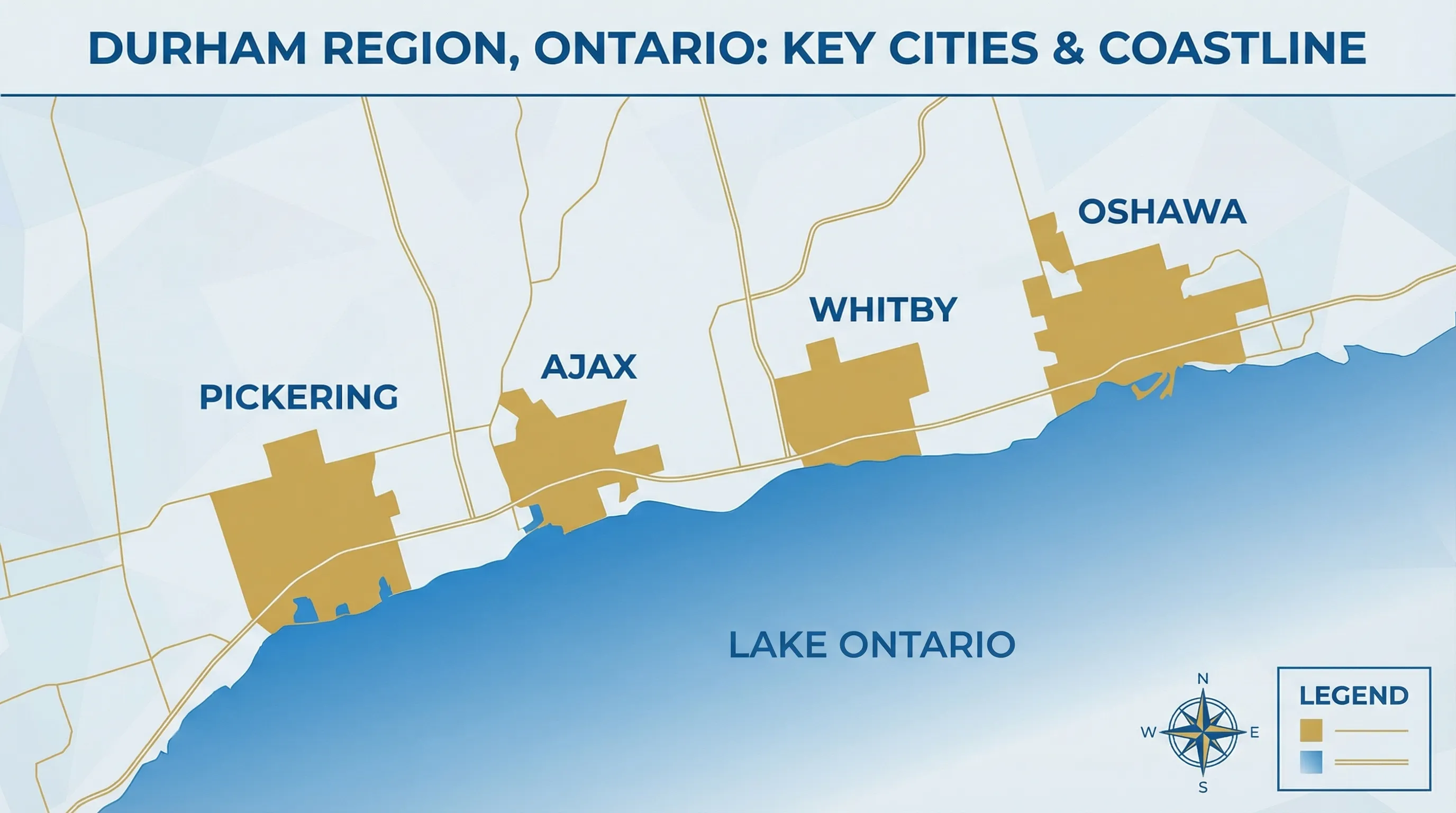
We are Ontario based and work across Durham: Oshawa, Whitby, Ajax, Pickering and Clarington. Most of the work happens remotely, which keeps the cost lower than a Toronto engagement carrying downtown overhead. On site matters for the physical parts, and for those we come to you.
We run on Canadian infrastructure, which is a practical requirement rather than a slogan for suppliers holding OEM contracts, healthcare organisations and anyone selling into government.
If you are elsewhere in the region, AI consulting for Durham Region covers Whitby, Ajax, Pickering, Clarington, Scugog, Uxbridge and Brock, and AI consulting in Whitby goes deeper on Whitby specifically. For the wider picture, how to tell whether your business is ready for AI consulting covers the same judgement without the manufacturing focus.
About the author
Kaxo CTO has over 20 years in software engineering and more than a decade in information security, with a focus on privacy-enhancing technology and compliance architecture for government and defence work. That background is the reason this page spends as much time on audit trails and data residency as on models: for a Durham supplier holding an OEM contract, those are usually the constraints that decide what gets built and what it costs.
Let’s talk
No pitch decks. An honest conversation about whether automation is the right answer for the problem you actually have, including when it is not.
Serving Oshawa, Whitby, Ajax, Pickering, Clarington, and all of Durham Region, Ontario.
Also serving: Kawartha Lakes | Peterborough | Durham Region | Toronto
Frequently Asked Questions
Do I need sensors on my equipment before AI is useful?
For predictive maintenance, yes, something has to be measuring the machine. For most other work, no. Quality inspection needs a camera and a light, not a retrofit. Scheduling, quoting, invoice handling and reporting run on data you already generate. If a vendor's first move is a plant-wide sensor installation, ask what the automation does that the sensors do not.
What does AI automation cost for a Durham Region manufacturer?
Most projects run $5K to $20K. The range is driven by integration, not by the AI. A vision inspection cell on one line with a clear pass or fail decision sits at the low end. Anything that has to write back into an ERP or MES, or that touches a system under an OEM audit trail, sits at the high end because the testing and documentation are the work.
How long before we see anything working?
You should see something running against your real data inside a few weeks, not at the end of a six-month programme. If the first milestone in a proposal is more than a month out, the risk is being pushed onto you: you find out whether it works after you have paid for most of it.
Will this pass an OEM quality audit?
It has to be built for that from the start. If you supply an automaker, the question is not whether the model is accurate but whether you can show what it decided, when, on what input, and who could change it. That means versioned models, retained inputs and an override log. Retrofitting an audit trail afterwards costs more than building it in.
Do you need to be on site in Oshawa?
For most work, no, and it keeps the cost down. On site matters for the parts that are physical: seeing the line run, placing a camera, understanding why the operator does the thing the SOP does not mention. That is usually a day or two, not a standing presence. We are in Ontario and we come to Durham when it is needed.
What if our production data is all in spreadsheets?
That is the normal starting point and it is not a blocker. A spreadsheet someone maintains daily is often better input than a database nobody trusts, because at least one person knows what the numbers mean. The work is usually to find that person and get the definitions right, which is a conversation rather than a systems project.
Is our data staying in Canada?
Yes. We run on Canadian infrastructure, which matters if you hold OEM contracts, work with healthcare, or sell into government. It is worth checking with any vendor: plenty of AI tooling sends your production data to a US API by default, and for some contracts that is a compliance problem before it is a technical one.