
TL;DR: How much does an AI agent cost? Off-the-shelf tools run roughly $0-500 a month, and a custom agent for one well-defined workflow typically costs $25,000-$150,000 to build. Those numbers cover the build; every agent also has a running cost and an operating cost, and the operating cost decides whether it still works in month six.
Contents
- How Much Does an AI Agent Cost?
- The Three Costs of an AI Agent: Build, Run, Operate
- What Drives the Build Cost
- What It Costs to Run an AI Agent Each Month
- The Operating Cost Most Quotes Leave Out
- Off-the-Shelf vs Custom: Which Price Fits Your Workflow
- How to Get a Quote You Can Trust
- Key Takeaways
How Much Does an AI Agent Cost?
An AI agent costs $0-500 a month off the shelf, or $25,000-$150,000 to build custom, plus running and operating costs.
The honest answer has three parts, because an agent has three costs. You pay once to build it, every month to run it, and continuously to keep someone responsible for it. Most quotes cover the first, some cover the second, and few mention the third, which is why quotes for the same agent can differ so widely.
If you only want a number to budget with, use the two ranges above and treat them as the start of the conversation. The rest of this guide explains what sits inside each range, and what a quote usually leaves out. For the wider picture of what agents do for a business, see our guide to AI agents for business.
The Three Costs of an AI Agent: Build, Run, Operate
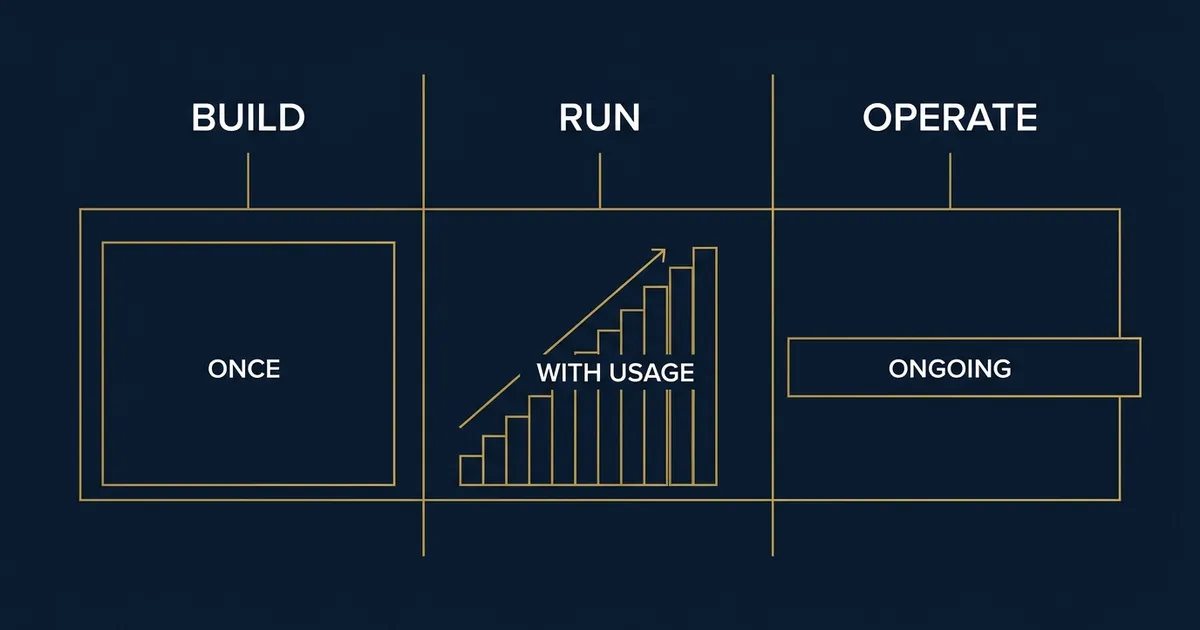
Every AI agent has three costs: build, run and operate. A quote naming only one is not the full AI agent cost.
Build is the one-time work of designing the agent, connecting it to your systems and testing it against real cases. Run is the monthly bill for the model usage and hosting that keep it working. Operate is the human time spent watching it, fixing it, and keeping its answers accurate.
Search results for this question mostly price the build, or the subscription for a ready-made tool. That is fair as far as it goes, but it leaves a buyer comparing a one-time number against a number that never stops. A fair comparison puts all three side by side over twelve months.
What Drives the Build Cost
The biggest driver of the cost to build an AI agent is integration complexity, not the model. The more systems it touches, the more it costs.
An agent that answers questions from a single clean document set is a small project. An agent that reads orders from one system, checks stock in a second, writes to accounting in a third and handles the exceptions in between is a much larger one. Each connection has its own login rules, data quirks and ways to fail.
Four things move the build price most:
- Number of integrations. Every system the agent reads from or writes to adds design, build and testing work.
- Data quality. Agents inherit the mess in your records. Cleaning it is often a real share of the project.
- Cost of a wrong answer. An agent that drafts internal notes needs less testing than one that sends invoices or talks to customers.
- Handling of exceptions. The happy path is cheap. Deciding what the agent does when something unexpected arrives is where the time goes.
This is why a single price list for custom agents does not exist. Two agents that sound identical in a sentence can sit at opposite ends of the $25,000-$150,000 range once you look at what they connect to. For the decision between building and buying, see AI agent builder: build vs buy.
What It Costs to Run an AI Agent Each Month
Running an AI agent costs model usage plus hosting, and both grow with the work it does. No single monthly figure fits every agent.
Model usage is billed per million tokens, with different rates for input and output and for different model sizes. Providers publish these openly, and they change, so read the current pages from Anthropic and Google rather than trusting any number quoted in an article, including this one.
Two things make this line easy to misjudge. A pilot that handles a few dozen tasks a day tells you little about the bill at a few thousand. And an agent that works through a long task in many steps uses far more than a single question and answer, so ask any vendor to estimate usage on your real volumes.
Hosting is usually the smaller line, but it is not zero. The agent has to run somewhere, with logging, access controls and backups, and that has a monthly cost whether you pay for it directly or it is folded into a managed fee.
The Operating Cost Most Quotes Leave Out
The operating cost is the human time that keeps an agent accurate after launch, and it decides whether the agent still works in month six.
An agent is not a finished product the way a spreadsheet template is. The systems it connects to change their fields, their logins and their limits.
Your business changes its prices, policies and products. The model underneath gets updated, and behaviour shifts with it.
Someone has to notice when an answer is wrong, find out why, and fix it before a customer does. That means monitoring, a way to review what the agent did, and a person with the authority to change it.
When nobody owns this, the agent does not fail loudly. It drifts, and people quietly stop trusting it.
We run our own agents in production every day, so we price this cost as a matter of course. It is the reason we offer managed AI agents as well as builds. If you are weighing what ongoing care should look like, talk to Kaxo about what your agent would cost.
Off-the-Shelf vs Custom: Which Price Fits Your Workflow
Choose off-the-shelf when your workflow is common and low-risk. Choose custom when the agent must fit your systems and your rules.
| Off-the-shelf or no-code | Custom build | |
|---|---|---|
| Up-front cost | Little or none | Roughly $25k-150k |
| Monthly cost | Roughly $0-500 subscription | Model usage plus hosting, billed to you |
| Operating cost | Inside the vendor’s fee | Your team or a partner watching the agent |
| Fits | Common, low-risk jobs | Processes specific to your business |
| Control | The vendor’s rules | Your rules and your systems |
Off-the-shelf and no-code tools, at roughly $0-500 a month, are the right AI agent pricing tier for standard jobs: scheduling, simple customer questions, summarising meetings, drafting routine messages. You get speed and a low commitment. You give up control over how the agent behaves and how it connects to anything unusual.
Custom work earns its price when the process is specific to you, when the agent must act inside several systems, or when mistakes are expensive. You pay more up front for something that fits, and you take on running and operating costs that a subscription would have hidden inside its fee.
A middle path is worth testing before you commit to a six-figure build. Start with an off-the-shelf tool on one narrow task and measure what it saves. If it works but hits a wall, you have a clear specification for the custom version, and a baseline to judge it against.
How to Get a Quote You Can Trust
A trustworthy quote says what happens after launch, not only what launch costs.
Most quotes look similar until you ask what sits inside the number. You do not need a long checklist to find out. You need a handful of plain questions, asked of every vendor, with the answers written down so you can compare them side by side:
- What exactly is included, and what would count as an extra?
- Which of my systems does the agent connect to, and who maintains each connection?
- What are the expected monthly running costs at my volumes, and what is that based on?
- Who watches the agent after launch, and what happens when it gets something wrong?
- What do I own at the end, and what happens if I want to leave?
Be careful with a quote well under $10,000 that promises a production-ready custom agent. At that price the usual result is a prototype: it works in a demonstration and struggles in daily use. A prototype can be a sensible first step, as long as everyone calls it that.
Also ask how the vendor knows their own agents work. Someone who runs agents in production can tell you what breaks. Someone who only builds them often cannot.
For help choosing between vendors, see how to choose an AI agent development company, and for what a build engagement covers, see our AI agent development service.
Key Takeaways
- Three costs, not one. Build, run and operate. Compare quotes across all three over twelve months.
- Know the ranges. Off-the-shelf tools run roughly $0-500 a month. A custom agent for one workflow typically costs $25,000-$150,000 to build.
- Integrations set the price. The number of systems the agent connects to matters more than the AI model.
- Never trust a quoted token rate. Read the providers’ current pricing pages and estimate on your real volumes.
- Operating is where agents survive or die. Ask who watches the agent after launch.
- Be wary of very cheap “production-ready” quotes. Well under $10,000 usually buys a prototype.
Ready to see what your own agent would cost across build, run and operate? Talk to Kaxo about what your agent would cost.
Soli Deo Gloria
Frequently Asked Questions
Are AI agents free to use?
Some are, within limits. Many no-code and off-the-shelf tools have a free tier that covers light testing, and paid plans for real business use typically run up to about $500 a month. A free agent still has costs: the time to set it up, the data you feed it, and someone checking that its answers are right.
How much does it cost to build an AI agent?
A custom agent for one well-defined workflow typically costs $25,000-$150,000 to build. Most of the spread comes from integration complexity: how many of your systems the agent has to read from and write to, and how messy the data in them is. The model itself is rarely the biggest line.
What does an AI agent cost per month to run?
Running cost is model usage, billed per million tokens, plus hosting. Both scale with how much work the agent does, and the operating cost of the people watching it comes on top. Check the providers' current pricing pages rather than trusting a quoted figure, because per-token rates change often.
Why do AI agent quotes vary so much?
Quotes differ because they price different things. One covers a prototype, another a production system with monitoring, and a third only the subscription. Scope, number of integrations, error handling and ongoing support all move the price, so ask each vendor what happens in month six.
Is a cheap AI agent worth it?
It can be, for a simple, low-risk task that an off-the-shelf tool already handles. It is rarely worth it when the agent touches customer data, money or several systems. A quote well under $10,000 for a production-ready custom agent usually buys a prototype, not something you can leave running.