
TL;DR: AI agent governance is the set of rules that decide what an agent may read and change, which actions a person must approve, how its work is recorded and how it is stopped. Agents act in your systems, so governance has to exist before launch, not after the first mistake. Require scoped access, human approval for irreversible steps, a full action log, a way to stop the agent and a named owner.
Contents
- What Is AI Agent Governance?
- Why Agents Need Rules a Chatbot Does Not
- The Controls AI Agent Governance Requires
- AI Agent Governance at a Glance
- What Goes Wrong Without Governance
- Test on Real Work Before Widening Access
- Ownership and Review After Launch
- Questions to Ask a Vendor or Your Team
- Key Takeaways
What Is AI Agent Governance?
AI agent governance is the set of rules that control what an agent can do in your systems. It covers what the agent may read and change, which actions need a person’s approval, how its work is recorded, and how you stop it. It is written down before launch and reviewed after.
The word “governance” makes this sound like a policy binder. For an agent it is closer to a job description with limits: what the agent is for, what it is allowed to touch, and who answers for it.
This guide sets out the controls worth requiring, what goes wrong without them, and the questions to ask a vendor. If you are still deciding whether you need an agent at all, start with our comparison of an AI agent vs a chatbot.
Why Agents Need Rules a Chatbot Does Not
An agent needs governance because it acts. A chatbot’s worst output is a wrong sentence, while an agent’s worst output is a changed record, a sent message or a payment. That gap in consequence is what the rest of this guide is built around.
An agent works toward a goal, picks its own steps and uses tools in your systems. You decide the limits, but you do not script every move. That freedom is the value, and it is also why the limits matter.
Governance is how you keep the value and cap the downside. The goal is not to slow the agent down. It is to make sure that when it is wrong, the damage is small, visible and reversible.
The Controls AI Agent Governance Requires
Seven controls cover most of what a small or mid-sized business needs. Each answers one plain question: what can the agent reach, what can it do alone, who can see what it did, and who can stop it. Missing any one leaves a gap the others cannot fill.
1. Scoped permissions
Give the agent the least access its job needs. If it drafts replies, it does not need to delete customer records.
Read access and write access are separate decisions, and so is each system.
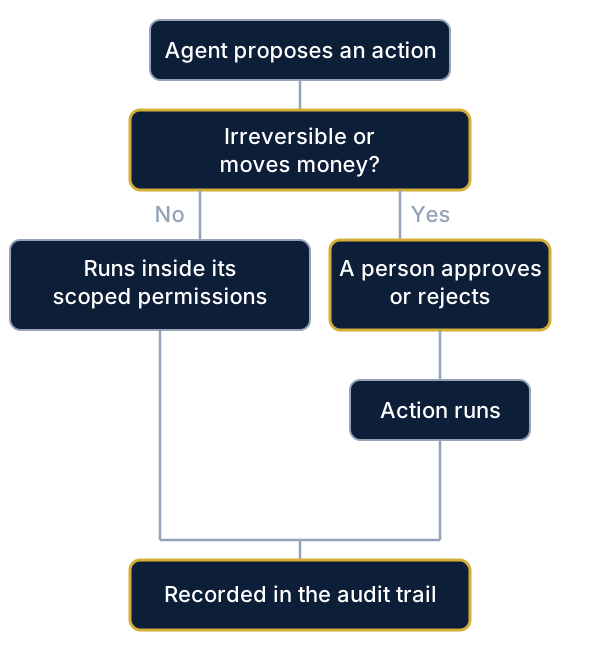
2. Human approval for irreversible or money-moving actions
Sending a payment, deleting data, emailing a customer list or changing a contract term should wait for a person. The rule is simple: if the action is hard to undo, someone confirms it first.
3. An audit trail of every action
Each step the agent takes should be recorded with what it did, in which system and when. Without a record, you cannot tell a good run from a lucky one, and you cannot investigate a bad one.
4. A way to stop it
Someone must be able to pause or switch off the agent within minutes, without calling the vendor. Test that this works before you need it.
5. A named owner
Every agent has one accountable person, and that person is named in writing. Shared ownership usually means nobody’s.
6. Data boundaries
Decide what the agent may read, and what it may send out of your systems. Customer data, financial records and staff information each need an explicit answer.
7. A review cadence
Agents and the business around them change. Set a regular point to review the log, the permissions and the results, so that access does not quietly widen over time.
For a broader reference on managing AI risk across an organization, the NIST AI Risk Management Framework is a widely used reference. It is written for organizations of all sizes and is a useful check on whether your own rules cover the ground. For agent-specific risks, the OWASP Top 10 for Agentic Applications for 2026 lists the most critical ones.
AI Agent Governance at a Glance
The table below turns the seven controls into what to require, why each one matters and what to ask a vendor. Use it as a checklist when you review a proposal, or when you look at an agent you already run and want to know where the gaps are.
| Control | What to require | Why it matters | What to ask a vendor |
|---|---|---|---|
| Scoped permissions | Least access the job needs, set per system | Limits what a wrong step can reach | “What can the agent read, and what can it change?” |
| Human approval | A person confirms irreversible or money-moving steps | Stops the costly mistakes from landing | “Which actions wait for sign-off, and who sees the request?” |
| Audit trail | Every action recorded with time and system | Lets you review, investigate and prove what happened | “Can I see a log of every action, in plain terms?” |
| Stop control | A pause or off switch you can use yourself | Caps the damage while you investigate | “How do I stop it, and how fast does that take?” |
| Named owner | One accountable person per agent | Someone answers for its behavior | “Who owns it on your side and on ours?” |
| Data boundaries | Written limits on what it reads and sends | Protects customer and company data | “Where does our data go, and what is kept?” |
| Review cadence | A scheduled check of log, access and results | Catches drift before it becomes a problem | “How often do we review, and who attends?” |
What Goes Wrong Without Governance
Without governance, the failures are ordinary and predictable. They are not dramatic. They come from an agent with too much access, no checkpoint and no record, working quietly until something goes wrong in front of a customer, a supplier or an auditor.
The patterns repeat across industries:
- Over-broad access. An agent given the same login as a manager can change things it was never meant to touch.
- Unreviewed irreversible actions. A message goes to the wrong list, or a record is overwritten, and there is no way to take it back.
- No log. Something is wrong in the data, and nobody can say whether the agent or a person caused it.
- Silent drift. Access is added for one task and never removed, so the agent’s reach grows without anyone deciding it should.
- No owner. The person who set it up has moved on, and the agent keeps running with nobody watching.
Each of these is a governance gap, not a model failure. A better model would not have closed any of them. Rules, a checkpoint and a record would have.
Test on Real Work Before Widening Access
Test an agent on real work, at limited access, before you widen it. A demo with clean sample data proves little. Real records are messy, and the mistakes an agent makes show up there, where they can be caught while the stakes are still low.
A sensible path starts narrow. Let the agent read and draft, with a person approving every action. Review what it did, correct it, and only then allow it to act alone on the steps where it has been reliably right.
Widen one permission at a time, and keep the log open as you do. If a result surprises you, narrow the access again. The point of staged access is that each step is small enough to reverse.
Cost follows scope here too. A narrow first stage is cheaper to build and easier to judge, and our guide to AI agent cost breaks down how scope drives the price.
Ownership and Review After Launch
After launch, someone must own the agent, and the work has to be reviewed on a schedule. An agent is a working part of your operations, not a finished install. The systems around it change, and so does its behavior.
The owner approves permissions, reads the log and decides when access widens or the agent pauses. Pick someone who understands the process the agent works in, not only the technology. A short, regular review is better than a long, rare one.
Not every business wants to carry this itself. Some hand the ongoing part to a provider, which is what managed AI agents cover. Others bring in outside help on the rules themselves, such as our AI security and compliance service.
We run agents in our own operation and hold them to the same rules we ask clients to adopt. If you want a second view on the limits for your own setup, talk to Kaxo about your agent plans.
Questions to Ask a Vendor or Your Team
Ask the same questions of an outside vendor and of your own team. The answers should be specific and in writing. Vague answers about “enterprise-grade security” or “built-in safeguards” are a signal to push harder, because the details are what protect you.
- What can the agent read, and what can it change, system by system?
- Which actions need a person to approve them before they happen?
- Is every action logged, and can I read the log without your help?
- How do I stop the agent myself, and how fast does it stop?
- Who owns the agent after launch, and who do I call when it is wrong?
- Where does our data go, what is stored, and what is it used for?
- How was it tested on real work, and how will access be widened?
- How often do we review it, and what happens to access that is no longer needed?
A provider who has built this before will answer these without hesitation. If you are choosing one, our guide to AI integration services covers what to look for in the wider relationship. For the build itself, see our AI agent development service.
Key Takeaways
- AI agent governance is the set of rules for what an agent may read, change, and do without approval.
- Agents act in your systems, so a mistake changes real records. That is what makes governance necessary.
- Require scoped permissions, approval for irreversible steps, a full action log, a stop control, a named owner, data boundaries and a review cadence.
- The common failures are over-broad access, no checkpoint, no log, silent drift and no owner. A better model fixes none of them.
- Test on real work at narrow access, and widen one permission at a time.
- Ask a vendor the same questions you would ask your own team, and expect specific answers in writing.
Planning to let an agent act in your systems? Talk to Kaxo about the rules to set first.
Soli Deo Gloria
Frequently Asked Questions
What is AI agent governance?
AI agent governance is the set of rules and controls that decide what an AI agent may read, what it may change, who approves its actions, how its work is recorded and how it is stopped. It exists because an agent acts in your systems, so a mistake changes real records instead of just producing a wrong answer.
How is AI agent governance different from general AI governance?
General AI governance covers policy, risk and accountability for AI across an organization. AI agent governance is narrower and more operational, because agents take actions. It adds controls a chat tool does not need: scoped permissions, approval for irreversible steps, a full action log and a way to switch the agent off.
Does a small business need AI agent governance?
Yes, though it can be light. The size of the business does not change the risk of an agent that can send email or change an invoice. A small business needs the same basics: limited access, a named owner, sign-off on money and an action log.
Who should own an AI agent inside a company?
One named person who understands the process the agent works in, not only the technology. That person approves its permissions, reviews its log and decides when it is widened or paused. An agent with a shared or unclear owner tends to drift, because nobody is responsible for its behavior.
What should I ask an AI vendor about governance?
Ask what the agent can access and change, which actions need a person to approve them, how every action is logged, how you stop it, and who owns it after launch. A vendor that can answer each of these plainly, in writing, has thought about governance. One that talks only about capability has not.