
TL;DR: An AI chief of staff is an always-on AI operator that handles an owner’s coordination load: inbox and calendar triage, follow-ups, status rollups across tools, prepared decisions and chasing open loops. It fails on judgment calls, relationships and context it was never given, and it should never move money or take irreversible steps without approval. Delegate the sorting and chasing, keep the deciding and the people.
Contents
- What Is an AI Chief of Staff?
- What an AI Chief of Staff Does Day to Day
- AI Chief of Staff vs Human Chief of Staff
- Where an AI Chief of Staff Fails
- What Stays Human
- How to Start With an AI Chief of Staff
- Questions to Ask Before You Hand Over Access
- Key Takeaways
What Is an AI Chief of Staff?
An AI chief of staff is an always-on AI agent that carries the coordination work between you and everything you run. It reads your inbox and calendar, tracks what is open, prepares what you need to decide and nudges people who owe you something. It works between your requests, not only when you ask.
The title borrows from a human role. In a company, a chief of staff is the person who keeps a leader’s time, information and follow-through in order. Harvard Business Review makes the case in “The Case for a Chief of Staff” that CEOs need more support than an executive assistant can provide.
Most owners of small and mid-sized businesses never hire that person. The load still exists: forty threads, six tools, a handful of promises made last week and nobody tracking them. That gap is why owners are asking whether an AI operator can fill it.
It can fill part of it. At Kaxo we build AI agents for owners, and this guide is about which part an agent can carry, and where you still need a person.
What an AI Chief of Staff Does Day to Day
An AI chief of staff does the sorting, tracking and preparing that eats an owner’s mornings. Its work falls into five jobs. Each one is repetitive, rule-shaped and easy to check, which is where an agent is most dependable, and each one maps to a task a human chief of staff handles daily.
Inbox and calendar triage
It reads what arrived overnight and sorts it into what needs you, what can wait and what someone else should answer. It drafts replies for the routine ones. It proposes meeting times against your real calendar, including the buffer you wanted before a call.
Follow-ups and open loops
This is the job people undervalue. A promise made in a meeting or a question left unanswered on a Thursday is the kind of thing that quietly dies. The agent keeps a list of what is owed to you and by you, and nudges the right person when a date passes.
Status rollups across tools
Your sales numbers sit in one system, open invoices in another and project status in a third. The agent pulls them into one short briefing each morning or week. You read one page instead of opening six tabs.
Preparing decisions
Before a meeting or a call, it assembles the thread history, the numbers and the open questions. When a choice is coming, it lays out the options and what each one costs, and says which it would pick. You still choose.
Chasing what is slipping
It notices the quote that has sat unanswered for nine days, the invoice that is overdue or the hire who has gone quiet. It brings those to you with a suggested next step, so a small slip does not become a lost customer.
None of this is glamorous. It is the work that a good human chief of staff does on a normal Tuesday, and it is most of what makes that person valuable.
AI Chief of Staff vs Human Chief of Staff
An AI chief of staff and a human one overlap on coordination and part ways on judgment. The agent is faster and more consistent on rule-shaped work, while the person is better wherever trust, nuance or accountability is involved. The table splits the work into delegate, approve and keep.
| Task | AI chief of staff | Human chief of staff | Who should own it |
|---|---|---|---|
| Sorting email and calendar | Fast, consistent, always on | Capable, but expensive for this work | Delegate to the AI |
| Tracking follow-ups | Never forgets a date | Forgets under load | Delegate to the AI |
| Weekly status rollup | Pulls from every tool in minutes | Hours of manual gathering | Delegate to the AI |
| Preparing a decision | Strong first draft of the options | Adds context the agent lacks | AI drafts, you review |
| Sending an email on your behalf | Drafts well, may miss tone | Knows the relationship | Approve before it sends |
| Paying a bill or changing a contract | Can do it, should not alone | Needs your sign-off too | Keep human approval |
| Handling a sensitive conversation | Poor judge of what is at stake | Reads the room | Keep human |
| Deciding strategy or who to hire | Can inform, cannot own | Can advise, cannot own | Keep with the owner |
The useful question is not which one is smarter. It is who answers for the result.
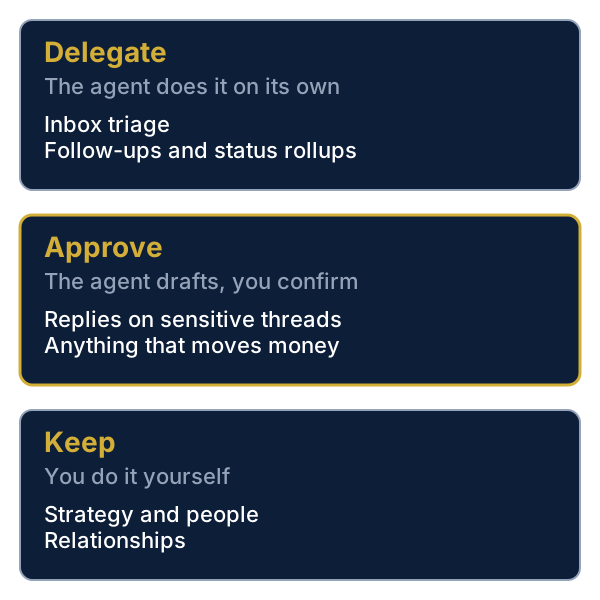
If you would rather have this split drawn for your own inbox and tools, talk to Kaxo about your setup and we will map what to delegate first.
Where an AI Chief of Staff Fails
An AI chief of staff fails in predictable places: judgment calls, relationships, steps that cannot be undone and anything it was never told. These are not bugs that a better model will remove. They follow from what an agent is, so plan around them instead of waiting for them to go away.
- Judgment calls. The agent can list the options for a difficult client. It does not know that you are about to renegotiate with them, or that the person on the thread is a friend of your biggest supplier.
- Relationships. A late reply that is merely efficient can read as cold. An agent has no feel for when a note should come from you personally, or not be sent at all.
- Irreversible actions. An email sent to the wrong list, a payment released or a record overwritten cannot be recalled. An agent should not do these without a person confirming first.
- Missing context. The agent only knows what it can see. Decisions made on a call, in a hallway or in your head do not exist for it unless someone writes them down.
- Confident errors. A summary can read smoothly and still be wrong. An agent that does not flag its uncertainty is worse than one that asks.
The common thread is that each failure is small when a person checks the work and expensive when nobody does. That is a design question about approval, not a reason to avoid the tool. Our guide to AI agent vs chatbot explains why an agent that acts needs more careful limits than a tool that only answers.
What Stays Human
The decisions, the relationships and the accountability stay with you. An AI chief of staff clears the path to them so your attention goes where it counts. It does not take them over, and if it is doing so, the setup has gone wrong.
- Strategy. What to build, whom to serve, where to grow and what to stop doing.
- People. Hiring, firing, hard feedback and the conversations where tone is the message.
- Money. Approving spend, signing contracts and deciding what you can afford.
- Trust. The customer who needs to hear from you, and the partner who expects it.
- Standards. What “good” looks like for your business, and when something falls short of it.
A good chief of staff, human or not, extends your reach and leaves the judgment with you.
How to Start With an AI Chief of Staff
Start narrow, with read access and drafts, and let the agent earn wider access. A first stage that only reads your inbox and prepares a daily briefing is easy to judge and low in risk. You see how often it is right before you let it act on anything.
A sensible path looks like this:
- Pick one painful loop. Choose the part of the week that costs you the most, such as inbox triage or follow-ups, and start there.
- Give read access only. Let the agent read and draft while you approve every action.
- Review for two to four weeks. Note what it gets right and where it misses.
- Allow low-stakes actions alone. Sorting, reminders and scheduling are good first candidates.
- Keep approval on the rest. Money, sensitive replies and anything irreversible stay behind your sign-off.
- Name an owner. One person, probably you at first, who reviews what the agent did and decides when its access changes.
Widen one permission at a time, the same staged approach AI agent governance applies across a team. If a result surprises you, narrow it again. The point of staged access is that each step is small enough to take back.
Scope also drives the price. A narrow setup is cheaper to build and easier to evaluate, and our breakdown of AI agent cost shows how scope moves the number.
Questions to Ask Before You Hand Over Access
Ask a vendor, or your own team, to answer these in writing before an agent touches your accounts. Specific answers mean someone has built this before and expects you to check. Vague ones about “smart automation” or “enterprise security” are a reason to slow down.
- What can it read, and what can it change, tool by tool?
- Which actions wait for my approval before they happen?
- Can I read a log of everything it did, without your help?
- How do I pause it myself, and how fast does it stop?
- Where does my email and customer data go, and is it stored?
- Who owns the agent after launch, and who do I call when it is wrong?
Some owners prefer to hand the ongoing care to a provider, which is what managed AI agents cover. If you want it built around your own tools and rules, that is the work of our AI agent development service.
We run an AI operator in our own business, and the lesson is the one above: the value comes from clear limits, not from handing over everything. If you want a second view on what an AI chief of staff could take off your plate, talk to Kaxo about your setup.
Key Takeaways
- An AI chief of staff is an always-on agent that takes on an owner’s coordination load across inbox, calendar and tools.
- It is strongest at triage, follow-ups, status rollups, preparing decisions and chasing what is slipping.
- It fails on judgment calls, relationships, irreversible steps and context it was never given.
- Delegate the sorting and chasing, approve anything that sends or spends, and keep strategy, people and trust.
- Start with read access and drafts on one painful loop, and widen one permission at a time.
- Ask for specific answers, in writing, on access, approval, logs, stopping it and ownership.
Soli Deo Gloria
Frequently Asked Questions
What is an AI chief of staff?
An AI chief of staff is an always-on AI agent connected to your email, calendar and business tools that takes on the coordination work a human chief of staff would carry. It sorts incoming requests, tracks open loops, prepares briefings and drafts follow-ups. You keep the decisions, the relationships and the final say on anything that cannot be undone.
Can an AI chief of staff replace a human one?
Not fully: an AI chief of staff covers the repeatable coordination work well, such as triage, reminders and status rollups, but it cannot carry trust, read a room or take responsibility for a hard call. For a small business that could never afford a human hire, it fills a real gap. For a larger one, it usually supports the person rather than replaces them.
What can an AI chief of staff do without my approval?
Anything low-stakes and easy to undo: sorting email, drafting replies, proposing meeting times, compiling a weekly summary and flagging overdue items. Anything that moves money, speaks for you on a sensitive matter or cannot be reversed should wait for your sign-off. You decide where that line sits, and you can move it as trust builds.
Is an AI chief of staff the same as an AI assistant?
No: an assistant answers when you ask, while an AI chief of staff works on its own between your requests, watching for open loops and bringing you what is slipping. The difference is initiative across several tools, not a smarter chat window. That initiative is also why it needs clear limits on what it can touch.
How much does an AI chief of staff cost?
The price depends on scope: how many tools it connects to, how much it does on its own and how much review you want. A narrow setup that triages email and prepares a daily briefing costs far less than one that works across your whole stack. Be wary of a quote given before anyone has looked at the tools you use.