TL;DR: Answer engine optimization (AEO) is the discipline of structuring content (schema, direct-answer paragraphs, FAQ markup) so AI systems like Google AI Overview, ChatGPT, and Perplexity cite it when answering user queries. Every AI citation is a surface where your brand gets mentioned without a click-through. If you’re publishing content about your business, this is now as important as traditional SEO. This guide covers the terminology confusion, what engines actually reward in a page, where FAQ content genuinely helps, how to tell whether it worked, and what the work costs.
Contents
- What answer engine optimization actually is
- AEO vs SEO vs LLMO vs GEO: the terminology map
- What AI answer engines actually look for
- What gets a page cited
- Where FAQ content fits
- Measuring whether it worked
- What does not work
- Cost of AEO at SMB scale
- Where AEO goes in 2026-2027
- Canadian angle: what changes for Canadian businesses
- Key Takeaways
- FAQ
Every definition of answer engine optimization online is written by someone who hasn’t shipped the content and checked whether it got cited. The Forbes piece frames it as brand strategy. The Coursera writeup explains what AI is. The CXL guide is well-intentioned but comes from a CRO lens.
For the broader business-side framing of why answer engines matter (not just the technical citation mechanics covered here), see our companion piece on LLMO search for businesses. If you are still working out whether any of this applies to you, start with AI search optimization and who actually needs it instead.
This is the practitioner version. We run a content pipeline on kaxo.io, we hold AI Overview citations, People Also Ask placements and ChatGPT mentions on specific queries, and what follows is written from that rather than from a framework.

What answer engine optimization actually is
Answer engine optimization is the practice of structuring content so AI systems cite it verbatim when answering user queries. The target isn’t a blue-link ranking. It’s the summary box at the top of a Google search, the ChatGPT response to a specific question, or the Perplexity citation that links to your page as the source.
Traditional SEO asks: how do I rank higher? AEO asks: how do I become the answer?
The mechanism is different. Google’s ranking algorithm weighs hundreds of signals and produces an ordered list of links. AI answer engines do something closer to document retrieval followed by generation: they find pages that contain credible, specific answers to the query, extract the relevant passage, and surface it. Pages that write for humans in a retrievable format get cited. Pages optimized for keyword density don’t.
Why it matters now: as of April 2026, Google AI Overview appears on roughly 50% of informational queries in the United States, according to Google’s own documentation on AI-powered search. ChatGPT has over 300 million weekly active users. Perplexity is doubling its user base roughly every six months. The share of searches that return a direct AI-generated answer before any blue link is growing. If your content isn’t structured to be cited, it doesn’t exist for a growing segment of searchers.
AEO vs SEO vs LLMO vs GEO: the terminology map
The field has a naming problem. Four terms describe roughly the same discipline, coined by different groups at different times. Here’s the map:
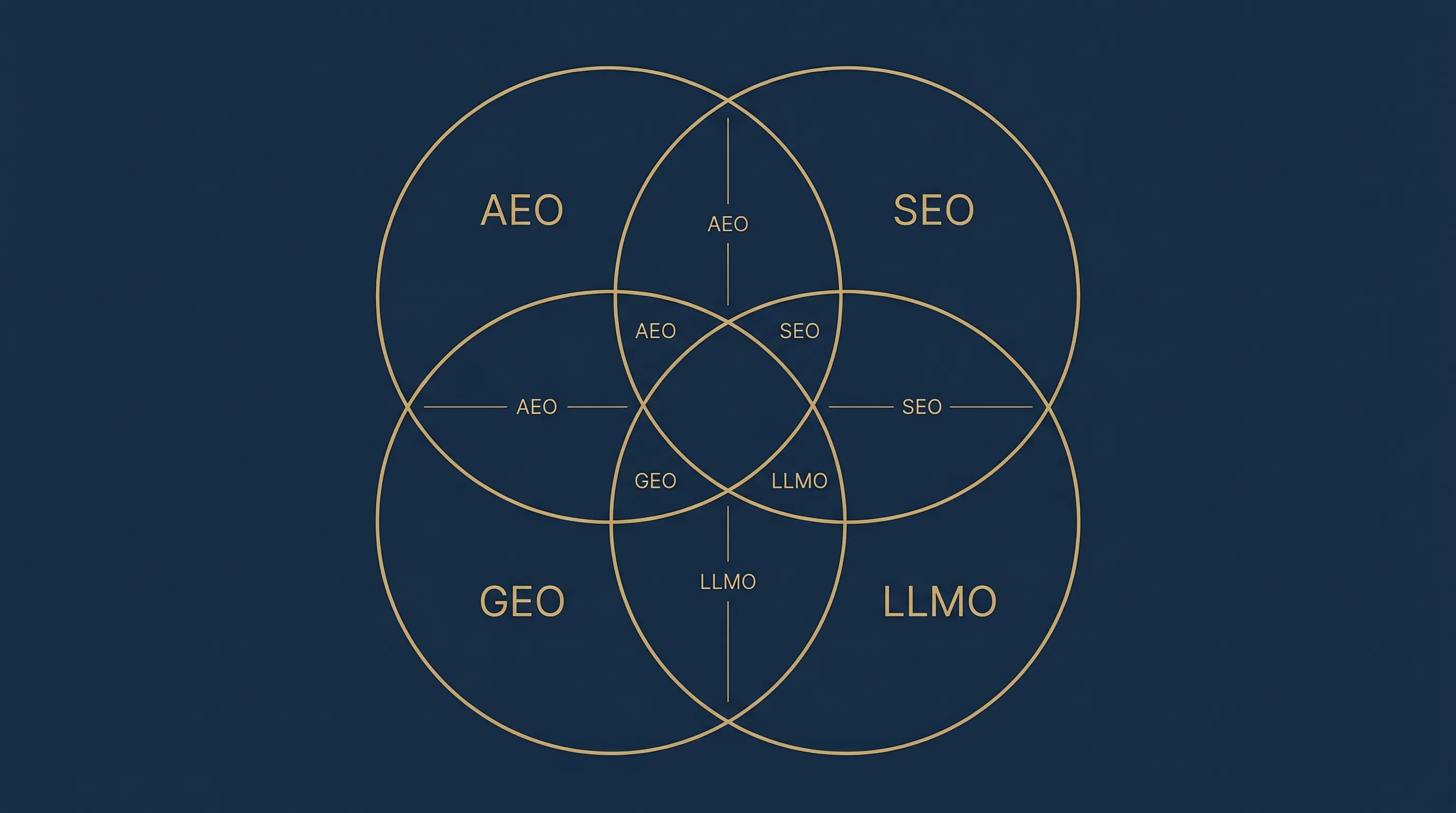
| Term | Coined by | Optimizes for | Status |
|---|---|---|---|
| SEO (Search Engine Optimization) | Industry standard | Blue-link rankings | Baseline discipline, still essential |
| AEO (Answer Engine Optimization) | Marketing/content community | AI answer citations, PAA, featured snippets | Dominant current term |
| LLMO (Large Language Model Optimization) | Technical community | LLM citations in ChatGPT, Claude, Perplexity | Earlier name for the same concept |
| GEO (Generative Engine Optimization) | Academic research | AI-generated search results | Same concept, academic coinage |
The practical reality: aeo vs seo is the question most people are actually asking. The answer is that they’re complementary. AEO, LLMO, and GEO all describe the same underlying discipline. The argument about which term is “correct” is less useful than building the content structures that work across all of them.
We wrote about this when LLMO was the dominant term in the earlier framing of this thinking. The concept hasn’t changed. The terminology has consolidated around AEO. That piece is still worth reading for the original context.
What AI answer engines actually look for
AI answer engines extract content that is direct, specific, and authoritative. A page gets cited when it gives AI systems something they can use as-is.
Direct-answer lead sentences. Every section should open with a one-sentence answer to the implicit question that section addresses. Not a setup paragraph. Not context. The answer first, then the explanation. AI systems pull the opening sentence of sections because it’s the most efficient extraction point. If your answer is buried in paragraph three, it doesn’t get extracted.
Specific factual claims with names, numbers, and dates. “LLM API costs run $50-200/month for most SMB agentic workflows at current pricing” gets cited. “AI tools can be expensive” doesn’t. Named entities (ChatGPT, Perplexity, Google AI Overview, Claude), dollar figures, percentages with sources, and dates tell AI systems this is a concrete, verifiable claim. Vague content has low citation probability because the system can’t verify it.
Questions people actually ask. Content built around the real queries in a category, not marketing-phrased softballs. An engine can only surface an answer to a question someone asked.
Clear authorship and recency. LLMs weight publication date and author authority when selecting citations. A post dated April 2026 with a named author beats an undated post on the same topic. This is why a machine-readable last-updated date matters: it signals when the content was last verified, and an engine has no other way to tell a maintained page from an abandoned one.
Clean HTML structure. AI crawlers parse heading hierarchies. An H1 with clear H2 sections, each containing a direct-answer lead paragraph, is optimized for extraction. Scroll-trap layouts, JavaScript-rendered content, and nested tab structures all reduce citation probability because they require execution to read. Static, well-structured HTML is the AEO baseline.
What gets a page cited
Answer engines do not read a page the way a person does. They look for a passage that answers the question on its own, and they take it. Everything else about the page is context.
That single fact explains most of why some pages get cited and comparable ones never do. It is rarely about writing quality or length. It is about whether the answer is somewhere an engine can lift it cleanly, or whether it is spread across three paragraphs that only make sense together. Most business writing is the second kind, because the instinct every good writer has is to build up to the point.
The gap between a page that gets cited and one that does not is usually structural, it is usually invisible to the person who wrote it, and it is fixable without rewriting the substance.
Where FAQ content fits
The questions a business puts on its own site are usually not the questions its buyers ask.
“What is answer engine optimization” is a real question people type. “How does AEO drive transformative business outcomes” is marketing copy wearing a question mark, and no engine will ever surface it, because nobody asked it. The gap between those two is where most FAQ sections sit.
The other half is the shape of the answer. Engines and search features truncate. An answer that only becomes correct by its third sentence does not survive the cut, and what gets shown instead is a competitor’s shorter one.
Measuring whether it worked
Without a reading from before you changed anything, you cannot attribute a later gain to anything you did, and you will be tempted to attribute it to whatever you did most recently.
The metric that matters is citation rate: of the questions your buyers actually ask, what share produce an answer that names you. Not traffic, not rankings, not impressions. Those can all move while your citation rate sits at zero, and they routinely do.
It is worth saying that this does not require expensive tooling to start. What it requires is asking the same questions in the same way on a regular cadence, and writing down what came back. The discipline is the hard part, not the software.
What does not work
Writing for the machine instead of the reader.
Every failed approach we have seen, our own included, reduces to that. Content shaped to look like what an engine might want reads as optimized, and engines are increasingly good at declining to quote it. Content that answers a real question clearly gets picked up. The second is harder, which is why so much effort goes into looking for a version of the first that works.
Cost of AEO at SMB scale
What follows is what the work costs rather than what it earns, because the second depends on your niche and the first does not. We run this on our own site, so these are not vendor estimates.
Content production per post: A practitioner-depth post takes most of a working day to write properly, which at a loaded rate puts it in the high hundreds of dollars. The technical groundwork is one-time template work rather than a per-post cost.
Ongoing measurement cost: Close to nothing in software terms. The cost of measurement is the discipline to do it on the same cadence with the same questions, which is a time cost and the one most businesses stop paying after a month.
How long before anything shows: Weeks rather than months, which is faster than blue-link ranking and the main reason the discipline is worth starting on. Informational questions get cited more readily than commercial ones, so the queries closest to a buying decision are the slowest to move and the ones worth being patient about.
ROI envelope: A cited post in Google AI Overview generates brand impressions on queries where we’d otherwise have zero presence. The value isn’t direct click traffic; it’s name recognition in AI-generated answers. For a B2B services firm, one inbound inquiry from a prospect who “saw Kaxo mentioned by ChatGPT” covers months of content production costs.
The agentic workflows guide covers what a first workflow costs to run. The content investment math is similar.
Where AEO goes in 2026-2027
The trend lines are not subtle.
AI Overview is now on roughly half of informational queries in the US. That percentage will keep rising. Google has a structural incentive to serve AI-generated answers: users who get direct answers stay in the Google ecosystem longer. The blue-link percentage will shrink, slowly at first and then quickly.
More AI engines entering the market means more surfaces to appear on. Gemini, Claude, Perplexity, and ChatGPT all have different citation patterns, but all reward the same underlying content signals. A well-structured, authoritative, specific page earns citations across all of them.
Brand mention becomes the unit of value, what some practitioners are now calling AI visibility. Traditional SEO measures success by clicks and rankings. AEO measures success by citations and AI visibility across ChatGPT, Perplexity, and Google AI Overview. A business that gets cited in ChatGPT responses for their category earns brand awareness even when the user never clicks through. This is closer to PR than traditional SEO. The content budget should reflect that.
Content depth beats content velocity. The SEO-era playbook of 30 keyword-targeted posts per month is dead for most businesses. One practitioner post with real specifics earns more AEO value than ten thin posts optimized for keyword density. Reduce volume. Increase depth.
Canadian angle: what changes for Canadian businesses
Canadian searchers get the same AI Overview as US searchers. There’s no regional version of Google AI Overview that would give Canadian content special placement for Canadian queries. The AEO discipline is the same regardless of location.
Where Canadian businesses have an edge: local and bilingual queries. If your content covers topics specific to Canadian regulations, industries, or business contexts (PIPEDA, SR&ED, provincial tax treatment), you face less competition for AEO placement on those queries than on generic international topics. Our location-specific content, like AI consulting in Toronto, gets cited on local-intent queries where the AI has fewer high-quality Canadian sources to pull from.
One consideration: no special data residency issue for AEO content itself. AEO is about how you structure publicly available content. The question of where your content is hosted matters less than whether it’s accessible to AI crawlers. Most static sites hosted on Cloudflare Pages or similar infrastructure are fully crawlable and AEO-eligible. The data residency concerns that apply to customer data in agentic workflows don’t apply here.
Key Takeaways
- Answer engine optimization targets AI citations, not blue-link rankings. Both matter. The disciplines are complementary, not competing.
- AEO, LLMO, and GEO are the same concept with different names. Stop arguing about terminology and build the page structures.
- Every H2 section should open with a one-sentence direct answer. This is the single highest-impact structural change you can make.
- Answering the questions people actually ask, in a form short enough to be quoted whole, is what puts a business into an answer.
- Measurement does not need expensive tooling. It needs a baseline taken before you change anything, and the same questions asked on the same cadence afterwards.
- A practitioner post with real specifics costs in the high hundreds of dollars to produce and earns citations within weeks. The ROI math works at SMB scale.
- Content depth is the equalizer. Small businesses with specific, practitioner-grade content outperform enterprise sites with generic coverage on AEO metrics.
Want an independent review of your AI stack?
If you are evaluating AI tools or platforms and want a structured review of fit, ROI, and implementation order before committing, see our AI Tools Audit service. Independent, Canadian, no vendor referral fees.
If you want help building an AEO-optimized content pipeline for your business, get in touch at kaxo.io/#contact. We scope the content structure, implement the schema, and set up the measurement layer. It is the core of our LLMO consulting practice.
For a deeper look at how AI agents use content in their workflows, see our agentic AI consulting services.
Soli Deo Gloria
Frequently Asked Questions
What is answer engine optimization?
Answer engine optimization (AEO) is the practice of structuring content so AI systems like Google AI Overview, ChatGPT, and Perplexity cite it when answering user queries. It focuses on earning citations and direct-answer placements, not just blue-link rankings. The core technique: lead every section with a one-sentence direct answer an AI can extract verbatim.
How is AEO different from SEO?
SEO optimizes for ranking in blue-link search results. AEO optimizes for being cited by AI answer engines. Both matter. SEO targets PageRank signals; AEO targets citation signals: direct-answer lead sentences, specific factual claims with dollar figures and dates, FAQ schema, and clear authority markers. You can rank #3 in SEO but never get cited. AEO changes what you're optimizing for.
Is SEO dead because of AEO?
No. As of April 2026, blue-link clicks still drive the majority of search-originated traffic. AI Overview appears on roughly 50% of informational queries in the US, but many searches still return standard results. SEO and AEO are complementary disciplines targeting different outcomes: rankings vs. citations. Run both. The signals overlap significantly.
Which answer engines matter most in 2026?
Google AI Overview is the highest-volume surface because it appears inline on Google Search. ChatGPT has the largest installed base among dedicated AI assistants. Perplexity is growing fastest in the research-intent segment. Gemini is significant for Google Workspace users. Claude is less frequently cited for commercial queries but matters in technical and professional contexts.
What schema markup helps with AEO?
Structured data is how a page tells a search or answer engine what it is, who published it, and what questions it answers. Getting it right is table stakes rather than an advantage - it is the thing that lets an engine consider you at all. The advantage comes from whether the content underneath it actually answers the question better than the alternatives.
How long does AEO take to show results?
Faster than traditional SEO. We've seen AI Overview citations appear within 2-4 weeks of publishing a well-structured post, compared to 3-6 months for blue-link ranking movements. The mechanism is different: AI systems re-crawl and re-evaluate sources continuously, not just on a ranking cycle. A post that earns one citation often earns more as engines gain confidence in the source.
Can small businesses compete on AEO against enterprise sites?
Yes, and in some cases more easily than in traditional SEO. AI answer engines weight specificity and direct answers more than domain authority. A practitioner post with real numbers, named tools, and dated observations beats a generic enterprise blog post. We've been cited in AI Overview for niche technical topics where we have no domain authority advantage. Specificity is the equalizer.