TL;DR: No, B2B SaaS automation isn’t dead. Anthropic launched Cowork: Claude Code on January 12, 2026, making their developer automation tool accessible to non-coders. It’s powerful for one-off tasks but doesn’t replace mission-critical SaaS workflows. Automation consultants aren’t obsolete—you’re MORE needed to help clients choose tools, assess risks, and architect hybrid solutions. Cowork is one tool in a growing toolkit. Security risks and Canadian compliance implications covered in our follow-up pieces.
Contents
- What Just Happened?
- What is Cowork: Claude Code?
- The Automation Spectrum
- What This Means for Consultants
- When to Use Cowork vs SaaS
- Key Takeaways
- FAQ
What Just Happened?
Anthropic announced Cowork: Claude Code yesterday. Within hours, automation consultants started asking if they’re obsolete.
Short answer: No. But the landscape is shifting.
Cowork: Claude Code takes Claude Code (Anthropic’s developer automation tool) and makes it accessible to anyone. No coding required. Point it at a folder on your computer. Tell it what to do in plain English. It handles the rest.
What it can do: Organize your Downloads folder. Build expense reports from receipt screenshots. Create slide decks from scattered notes. Extract data from PDFs.
What it can’t do: Replace recurring SaaS workflows. Run autonomously without oversight. Guarantee compliance out of the box.
The fear I’m seeing: Category confusion. People hear “AI agent” and assume full autonomy. Cowork: Claude Code isn’t that. Understanding where it actually fits changes everything.
What Is Cowork: Claude Code?
Cowork: Claude Code is Anthropic’s play for mainstream automation. Built in about 1.5 weeks using Claude Code itself, according to TechCrunch .
How it works:
- Install Claude Desktop (macOS only for now)
- Point Cowork: Claude Code at a specific folder
- Give instructions through normal conversation
- Claude reads, writes, edits, and organizes files in that folder
Technical foundation: Built on the Claude Agent SDK. Same underlying technology as Claude Code. Difference is user experience. Claude Code requires technical knowledge. Cowork: Claude Code doesn’t.
Availability: Research preview. Claude Max subscribers only ($100-200/month). Waitlist for other tiers.
Security approach: Uses Apple’s VZVirtualMachine for sandboxing. Better than nothing, but security researcher Simon Willison notes this provides protection while still carrying risks we’ll cover in our security deep-dive piece.
Quick Comparison
| Feature | Traditional SaaS (Zapier, Make) | Cowork: Claude Code |
|---|---|---|
| Task execution | Click workflows, if-this-then-that | Natural language prompts |
| Pricing | Monthly subscription | Usage-based (Claude Max) |
| File access | Cloud storage integrations | Direct local folder access |
| Learning curve | Setup wizards | Conversational |
| Recurring workflows | Excellent | Manual restart required |
| One-off tasks | Overkill | Perfect fit |
| Compliance logging | Built-in audit trails | Limited visibility |
The key distinction: Cowork: Claude Code excels at intelligent one-off tasks. SaaS tools excel at reliable recurring workflows.
Most businesses will use both.
The Automation Spectrum: Where Cowork: Claude Code Actually Fits
The confusion I’m seeing comes from conflating different levels of automation autonomy. Here’s the framework I use with clients:
Level 1: RPA (Robotic Process Automation)
Example: UiPath, Automation Anywhere Execution: Pre-programmed workflows, zero deviation Use case: Invoice processing, data entry Autonomy: None. Follows script exactly.
Level 2: Workflow Automation (SaaS Tools)
Example: Zapier, Make, n8n Execution: If-this-then-that rules Use case: Slack notifications, email sequences Autonomy: Rule-based branching only
Level 3: Task-Based AI Automation (Cowork: Claude Code)
Example: Cowork: Claude Code Execution: User-initiated, bounded task completion Use case: File organization, data extraction, content assembly Autonomy: Executes multi-step plan within single session Asks permission: For major actions
This is where Cowork: Claude Code lives.
Level 4: Agentic AI (Semi-Autonomous)
Example: Claude Code (for developers), GitHub Copilot Workspace Execution: Multi-step reasoning, autonomous within project scope Use case: Code refactoring, automated testing Autonomy: Continuous operation within defined boundaries
Level 5: Autonomous Agents (True Agents)
Example: AutoGPT, AgentGPT (experimental) Execution: Indefinite operation, self-directed goal pursuit Use case: Multi-day research projects Autonomy: High. Requires active monitoring.
Real-world example: OpenClaw is the most prominent Level 5 agent — a self-hosted autonomous AI that manages email, calendars, and messaging without human initiation.
Level 6: AGI (Artificial General Intelligence)
Example: Doesn’t exist yet Execution: Human-level reasoning across all domains Autonomy: Complete
Why This Matters
Most fears about “AI replacing SaaS” conflate Level 3 tools (Cowork: Claude Code) with Level 5+ capabilities (autonomous agents).
Cowork: Claude Code is NOT an autonomous agent. It’s a smart task runner. You initiate. It executes within bounds. It asks before taking destructive actions.
When someone asks “Will Cowork: Claude Code replace my automation stack?” the answer depends on what level your current tools operate at. If you’re running Zapier workflows that fire every time a Stripe payment succeeds, Cowork: Claude Code isn’t a replacement. It’s a complement for the one-off organizational tasks Zapier doesn’t handle well.
What This Means for Automation Consultants
No, you’re not obsolete. You’re MORE needed.
Why Cowork: Claude Code Creates Demand for Consultants
Decision paralysis: Clients now face choice overload. Zapier or Cowork: Claude Code or custom automation or n8n or Make. They need strategic guidance on which tool fits which workflow.
Integration complexity: Cowork: Claude Code doesn’t replace enterprise workflows. It complements them. Someone needs to architect hybrid solutions . That’s us.
Risk assessment: Every client will ask “Should we use Cowork: Claude Code?” They need security auditing, compliance review, risk assessment expertise. New service line. (We’ll cover security risks and Canadian compliance implications in our follow-up pieces.)
Training and governance: Teams need policies, not just tools. Who gets folder access? What data is off-limits? How do we audit usage? Change management work.
Failure recovery: When Cowork: Claude Code screws up (and it will), clients call consultants.
New Consulting Opportunities
- Hybrid automation architecture (Zapier + Cowork: Claude Code + custom APIs)
- Tool selection frameworks
- Security and compliance assessments (detailed analysis coming in pieces #2 and #3)
- Prompt engineering training for non-technical teams
- Governance policy development
Historical Parallel
When Zapier launched in 2011, automation consultants worried it would replace custom integration work. Instead, Zapier created the “no-code consulting” industry. Businesses could build workflows themselves, so they hired experts to tell them WHICH workflows to build.
Cowork: Claude Code follows the same pattern. More accessible tools create MORE demand for expertise, not less.
Why: Decision-making is harder than execution. Clients can now execute almost anything. They still need experts to tell them what’s worth executing and how to do it safely.
AI tools don’t replace consultants. They replace DIY guessing. Businesses still need experts to choose, configure, secure, and optimize.
When to Use Cowork: Claude Code vs Traditional SaaS
Practical decision framework:
Use Cowork: Claude Code When:
✅ One-off tasks: Organize Downloads folder, extract data from 50 screenshots ✅ Non-recurring workflows: Vacation research, event planning ✅ Personal productivity: Individual contributor tasks ✅ Non-sensitive data: Public information, personal notes ✅ Experimentation: Research preview stage, test new approaches
Use Traditional SaaS When:
✅ Recurring workflows: Daily Slack notifications, weekly reports ✅ Team collaboration: Multiple users need access ✅ Compliance requirements: Audit trails, data residency controls ✅ Sensitive data: Customer information, financial records ✅ Production systems: Mission-critical operations with SLAs ✅ Integration ecosystem: Need to connect 10+ tools reliably
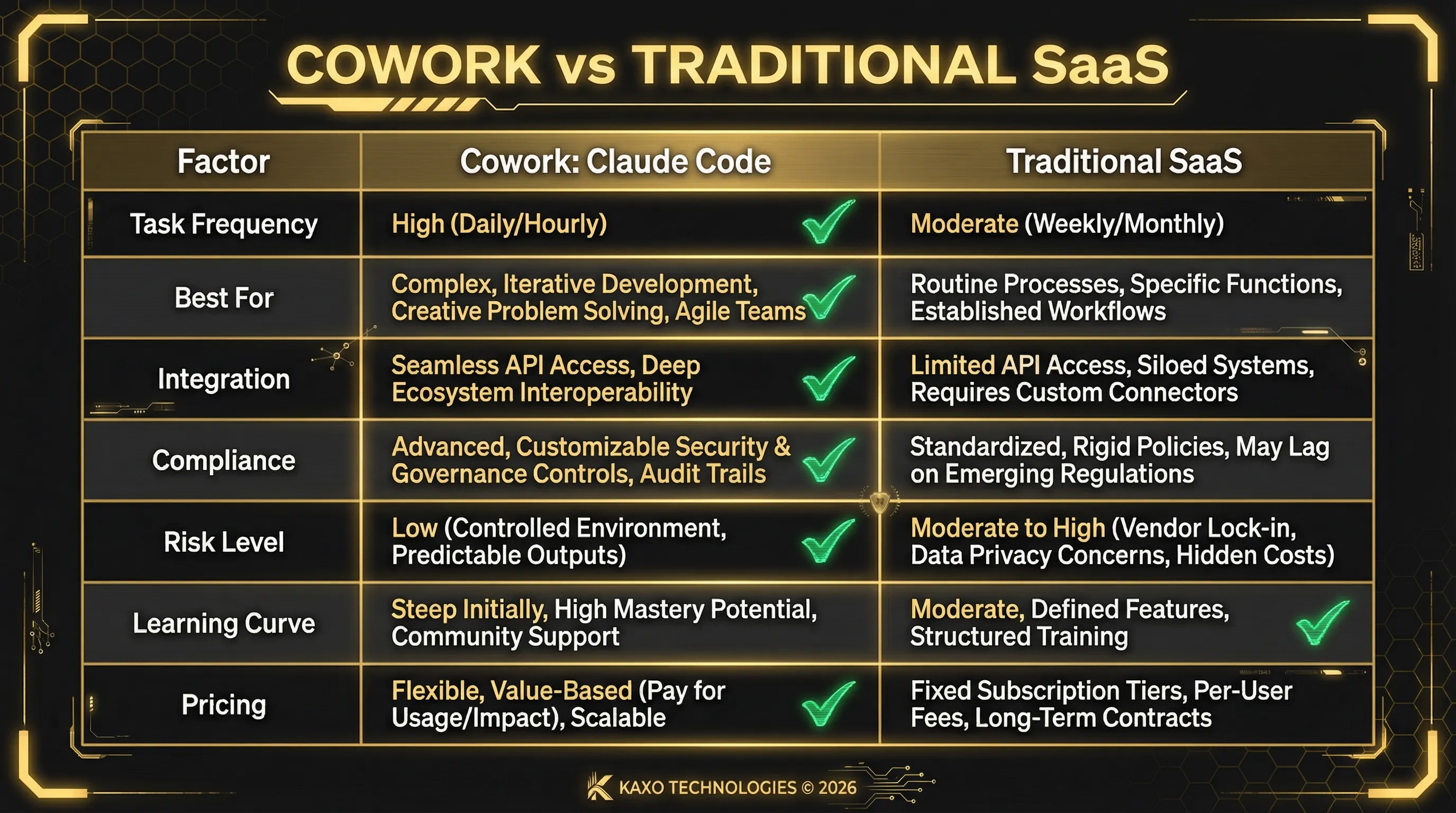
Cowork: Claude Code excels at ad-hoc intelligence. SaaS tools excel at reliable execution. Most businesses will use both.
For detailed security analysis and Canadian compliance considerations, see our follow-up pieces in this series. Learn more about how AI is transforming search visibility and building sovereign AI infrastructure .
FAQ
What is Cowork: Claude Code?
Cowork: Claude Code is Anthropic’s tool that gives Claude access to a folder on your computer to read, write, and organize files through natural language conversation. Built on the same technology as Claude Code (Anthropic’s developer tool), Cowork simplifies the interface for non-technical users. Currently available as a research preview for Claude Max subscribers on macOS.
Is Cowork: Claude Code an AI agent?
No, not in the autonomous sense. Cowork: Claude Code is task-based automation (Level 3 on the Automation Spectrum). You initiate tasks, Claude executes within a single session, and it asks permission for major actions. True AI agents (Level 5+) operate continuously and make strategic decisions independently. Cowork is closer to an intelligent assistant than an autonomous agent.
Can Cowork: Claude Code replace Zapier, Make, or n8n?
Not for recurring workflows. Cowork: Claude Code excels at one-off tasks: organizing 500 downloaded files, extracting data from a pile of screenshots, creating a report from scattered notes. Zapier and similar tools excel at recurring automated workflows: “Every time X happens, do Y.” Most businesses will use both—Cowork: Claude Code for intelligent ad-hoc tasks, SaaS tools for reliable recurring execution.
Will Cowork: Claude Code make automation consultants obsolete?
No. Cowork: Claude Code creates MORE demand for automation expertise. Businesses now face choice overload: Zapier vs Cowork: Claude Code vs custom automation vs n8n. They need consultants to assess which tool fits which workflow, conduct security audits, ensure compliance, architect hybrid solutions, and train teams on governance. Historical parallel: Zapier didn’t kill automation consulting, it created the no-code consulting industry.
When should I use Cowork: Claude Code vs traditional automation?
Use Cowork: Claude Code for: one-off tasks, non-recurring workflows, personal productivity, non-sensitive data, and experimentation. Use traditional SaaS automation (Zapier, Make) for: recurring workflows, team collaboration, compliance-required operations, sensitive data, production systems, and multi-tool integrations. Decision factors: task frequency, data sensitivity, user count, compliance needs, and risk tolerance. See the decision matrix above for details.
Is Cowork: Claude Code safe for my business?
Security depends on your data and risk tolerance. Cowork: Claude Code processes files by sending data to Anthropic’s servers, which has implications for data residency and compliance. For non-sensitive data (marketing assets, public content), risk is lower. For regulated data (customer info, PHI, financial records), you need careful assessment of prompt injection risks, data exfiltration potential, and mitigation strategies.
Does Cowork: Claude Code work with Canadian data privacy laws?
It depends on how you use it. If you’re processing personal information of Canadian residents, PIPEDA applies. Key questions: Where does Anthropic store data? Do you have consent for cross-border transfer? Does Anthropic’s Data Processing Agreement meet your requirements? Consider PIPEDA requirements, industry-specific concerns, and applicable compliance frameworks for your use case.
Key Takeaways
- B2B SaaS automation isn’t dead. Cowork: Claude Code is a new tool, not a replacement for existing workflows.
- Cowork: Claude Code = Level 3 automation. Task-based, user-initiated, bounded execution. Not an autonomous agent.
- Automation consultants are more valuable, not less. Tools multiply. Expertise in choosing them becomes critical.
- Hybrid solutions win. Zapier for recurring tasks, Cowork: Claude Code for one-offs, custom automation for complex integrations.
- Security and compliance matter. See our upcoming pieces for detailed analysis of risks and Canadian PIPEDA implications.
The Real Question
“Is SaaS dead?” misses the point.
The real question: “What’s the RIGHT tool for each workflow?”
Cowork: Claude Code isn’t killing SaaS automation. It’s expanding the toolkit. Five years ago, you had manual processes or expensive custom development. Today you have RPA, workflow automation, task-based AI, agentic AI, and everything in between.
The skill that matters isn’t knowing one tool. It’s knowing which tool to use when.
Expertise in choosing, configuring, and securing automation tools is more valuable than ever.
Coming up in this series:
- Piece #2: Security deep-dive (prompt injection, data exfiltration, mitigation strategies)
- Piece #3: Canadian compliance (PIPEDA implications, industry-specific requirements)
Need help assessing whether Cowork: Claude Code fits your automation strategy? Kaxo specializes in helping Canadian businesses navigate AI automation decisions with security and compliance in mind. Book a discovery call .
The future of work isn’t “AI OR automation.” It’s knowing which tool to use, when, and how to use it safely.
Soli Deo Gloria
Sources:
- TechCrunch: Anthropic’s new Cowork tool offers Claude Code without the code
- Simon Willison: First impressions of Claude Cowork
- VentureBeat: Anthropic launches Cowork