
TL;DR: Data sovereignty in Canada means your data stays under Canadian legal control. It is not the same as data residency. PIPEDA does not require physical Canadian storage, but it does require comparable protection for cross-border transfers. The gap most businesses miss: every time you send data to a US-based AI tool, that data crosses the border and exits Canadian legal protection. The answer is sovereign AI: running AI on infrastructure you control, in Canada.
This article is general information, not legal advice. For compliance requirements specific to your organization, consult a qualified Canadian privacy lawyer.
What is data sovereignty in Canada, and how is it different from data residency?
Data sovereignty in Canada means your data is governed by Canadian law. Specifically, it means the organization controlling your data is subject to Canadian jurisdiction, and foreign governments cannot compel access to it under their own laws.
Data residency is narrower: it means the data is physically stored on servers located in Canada. Residency and sovereignty often overlap, but they are not the same thing. A US company can operate servers in Toronto and still be subject to US law. Your data sits in Canada, but the company holding it answers to Washington.
This distinction matters more than it used to, because several major AI providers are US-headquartered while offering Canadian infrastructure.
The practical test: If a foreign government issues a legal order to the organization that holds your data, does Canadian law protect you? For a Canadian-controlled organization, yes. For a US-headquartered provider, even one running Canadian servers, the answer is less clear. The US CLOUD Act is the specific mechanism worth understanding: it allows US authorities to compel US-based cloud and communications providers to produce data they hold, under US legal process, even when that data is stored abroad.
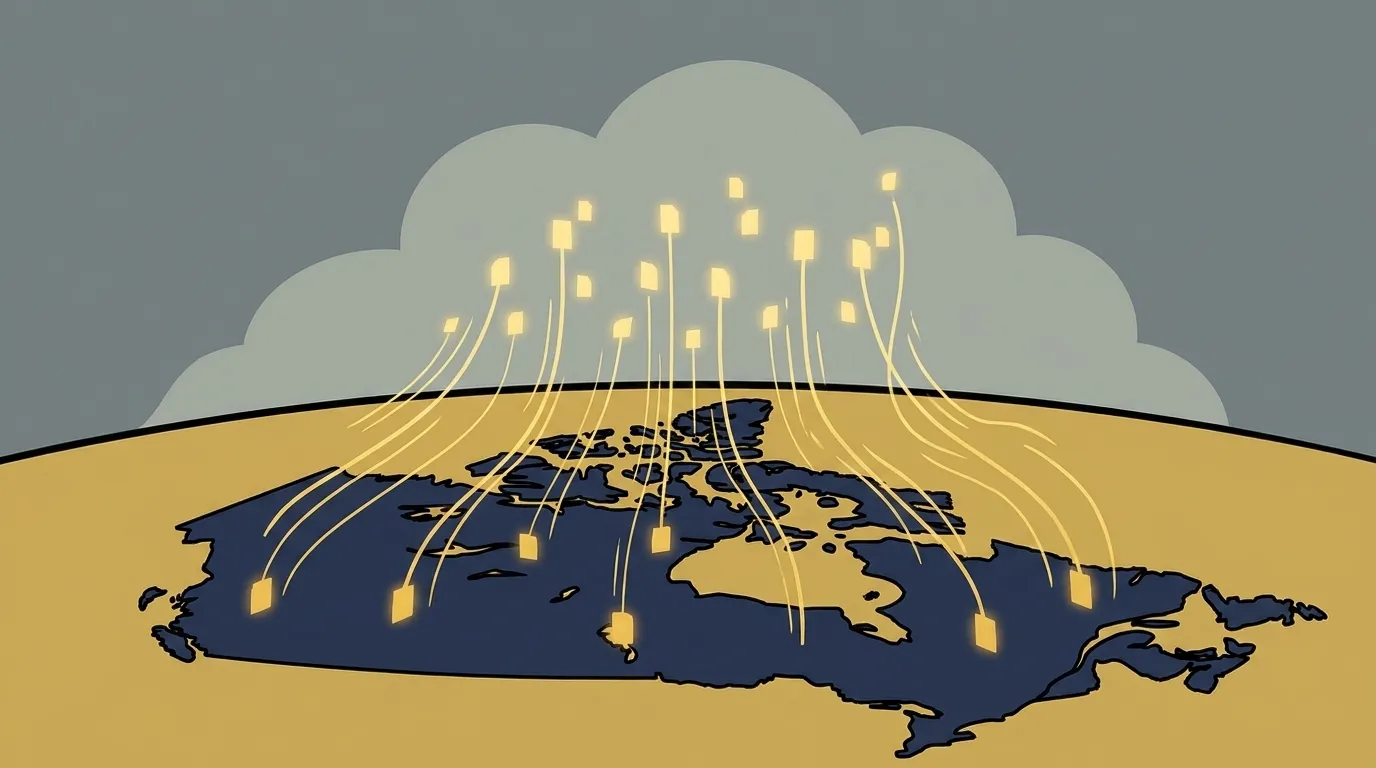
Does PIPEDA require personal data to be stored in Canada?
No. This is one of the most common misunderstandings in Canadian privacy compliance.
PIPEDA, Canada’s federal private-sector privacy law, does not broadly mandate that personal data be physically stored in Canada. What it requires is comparable protection: when an organization transfers personal data to a third party (including across borders), it must ensure that party provides a comparable level of protection, and it must be transparent and accountable about those transfers.
According to the Office of the Privacy Commissioner of Canada (priv.gc.ca), organizations can legally transfer personal data outside Canada under PIPEDA, provided they take steps to protect the data and inform individuals that their data may be subject to foreign law.
PIPEDA has not been replaced. A proposed federal overhaul, Bill C-27, died when Parliament was prorogued in early 2025 and has not been reintroduced, so PIPEDA remains the federal private-sector standard. In practice, many organizations now treat Quebec’s Law 25 as the stricter benchmark to design for.
The accountability is real. If a breach occurs in a foreign processor’s environment, the Canadian organization that transferred the data remains accountable under PIPEDA.
What PIPEDA does NOT do: It does not give individuals the right to demand Canadian-only storage. It does not prohibit cross-border transfers. It does not override US law when a US-headquartered company receives your data.
What changes the picture: Quebec’s Law 25 is stricter than PIPEDA in several areas, including data minimization and consent. It is in force and applies to any organization handling personal data of Quebec residents. Government-of-Canada procurement frequently carries explicit Canadian-residency requirements for sensitive data. Public-sector organizations and regulated industries (healthcare, financial services) often face additional requirements beyond PIPEDA.
What is a sovereign cloud, and what options exist in Canada?
A sovereign cloud is a cloud environment designed to keep data under the legal control of a specific jurisdiction. In practice, this typically means: physical data residency in that country, encryption key management by a local entity, contractual restrictions on foreign-government access, and an operating entity subject to local law.
People searching for a data sovereignty cloud in Canada are usually asking one of two different questions without separating them: whether the data sits on Canadian soil, or whether a Canadian court is the only court that can compel it. A Canadian cloud region answers the first. Only the operator’s own legal domicile answers the second, and the two rarely come from the same purchase.
In Canada, the major hyperscalers operate Canadian regions:
- AWS: Canada (Central) in Montreal, Canada West in Calgary
- Microsoft Azure: Canada Central (Toronto), Canada East (Quebec City)
- Google Cloud: Montreal and Toronto regions
These regions provide physical data residency in Canada. For many workloads, that is sufficient. For regulated or sensitive workloads, the residency-versus-sovereignty distinction re-enters the picture: these providers are US-headquartered, and they operate under US law including the CLOUD Act.
A genuinely sovereign option means the operating organization is subject to Canadian law and not to conflicting foreign legal orders. That points toward Canadian-headquartered cloud providers, government-community clouds with explicit sovereignty guarantees, or self-hosted infrastructure where you control the hardware, the software stack, and the encryption keys.
So “Canadian cloud” is not one product category but two, and a data sovereignty cloud in the stricter sense is the smaller of them.
The takeaway for buyers: Ask your provider two questions. First, where is the data physically stored? Second, which government can legally order access to that data? Residency answers the first question. Sovereignty answers the second.
Is my data still sovereign if I use US-based AI tools like ChatGPT?
No. This is the gap most Canadian businesses have not addressed.
When you send a prompt to ChatGPT, Microsoft Copilot, Google Gemini, or any US-hosted AI API, that data crosses the border. It is processed on infrastructure operated by a US-headquartered company, subject to US law. Your Canadian privacy obligations do not follow the data across that border.
The specific risks depend on the provider’s data handling policies: whether prompts are retained, whether they are used for model training, and whether they are accessible to the provider’s staff. Those policies vary and change. What does not change is the jurisdiction: once data is in a US system, Canadian law cannot protect it from US legal process.
For most businesses, the practical exposure is data that should not leave Canada at all: customer PII, confidential business information, regulated health or financial data, legal matter details, internal strategy. These get pasted into AI tools routinely, without any sovereignty analysis.
The EU figured this out before Canada did. GDPR-driven enforcement has produced multiple rulings against transferring EU data to US AI services without adequate safeguards. Canadian regulators are moving in the same direction. Public-sector organizations and regulated industries in Canada are already seeing this reflected in procurement requirements.
The solution is not to stop using AI. It is to run AI on infrastructure that keeps the data under your control.

How can a Canadian business keep its data and its AI sovereign?
The direct answer: run your AI on infrastructure you control, in Canada.
This means deploying large language models locally or on Canadian-resident servers, rather than routing queries to US cloud AI services. Your prompts never leave your environment. Your data never crosses the border. Foreign governments have no legal path to compel access to a server you operate in Canada under Canadian law.
This is not a hypothetical future. Capable open-weight models are available today that run on modern server hardware and match or approach the capability of cloud AI services for most business tasks. The infrastructure to run them reliably in production exists. The harder part is the implementation: standing up the hardware, configuring the models, building the workflows that use them, and maintaining the stack over time.
That is what Kaxo does. We run our own sovereign infrastructure and we deploy what we sell. Our own agent systems run on hardware we control, using local LLMs where the data never leaves our environment. When we build this for clients, we are not recommending something we have not done: we are deploying the same architecture we operate ourselves.
For Canadian businesses evaluating sovereign AI, the options range from fully managed to fully self-hosted:
- Self-hosted on Canadian hardware: Maximum sovereignty, maximum control. You own the hardware, the model weights, the data. Requires infrastructure capability.
- Managed sovereign deployment: A provider (in Canada, subject to Canadian law) operates and maintains the infrastructure. Sovereignty depends on the provider’s legal structure and contractual guarantees.
- Hyperscaler Canadian region with additional controls: Physical residency in Canada, but under a US-headquartered provider. Adequate for many workloads, not adequate where foreign-government access is a concern.
For most Canadian businesses outside regulated industries, option 3 is a reasonable starting point. For businesses handling sensitive data, operating in regulated sectors, or selling to government, options 1 or 2 are the ones worth examining.
Our AI security and compliance work covers the full stack: assessing your current exposure, identifying which data workflows cross the border, and building the sovereign AI architecture that closes the gap.
Key Takeaways
- Data sovereignty and data residency are not the same. A foreign-headquartered company can operate Canadian servers and still answer to foreign law.
- PIPEDA does not require data to stay in Canada. It requires comparable protection for cross-border transfers and accountability when things go wrong.
- Quebec Law 25 is stricter. For organizations handling Quebec resident data, it adds requirements beyond PIPEDA.
- The US CLOUD Act is the specific risk to name. US-headquartered providers can be compelled to produce data they hold, even data stored in Canada.
- AI tools are the unaddressed border crossing. Most Canadian businesses sending data to US AI services have not done a sovereignty analysis on those workflows.
- Sovereign AI means running AI on infrastructure you control. Local LLMs on Canadian-resident hardware keep data under Canadian legal protection.
- Public-sector and regulated buyers face explicit residency requirements. This is increasingly a procurement gate, not just a preference.
If you are weighing this as a purchase rather than a concept, our Canadian data sovereignty and sovereign cloud page covers what a Canadian region actually gets you and when the premium is not worth paying.
Frequently Asked Questions
What is data sovereignty in Canada?
Data sovereignty means your data is governed by the laws of the country where it is processed or stored. In Canada, this means data handled by Canadian organizations is subject to Canadian privacy law including PIPEDA federally and Quebec Law 25 provincially. Data sovereignty is distinct from data residency: data can reside physically in Canada but still be legally accessible to foreign governments under extraterritorial laws if the organization controlling it is foreign-headquartered.
Does PIPEDA require personal data to be stored in Canada?
No. PIPEDA does not broadly require personal data to be physically stored in Canada. It requires organizations to provide comparable protection when transferring data to third parties, including cross-border transfers, and to be transparent and accountable about those transfers. An organization can legally store personal data outside Canada under PIPEDA as long as it ensures comparable protections apply. For specific compliance requirements, consult a Canadian privacy lawyer.
What is a sovereign cloud, and what options exist in Canada?
A sovereign cloud is a cloud environment designed to keep data subject to a specific country's laws, typically through local data residency, local control of encryption keys, and contractual guarantees limiting foreign government access. In Canada, hyperscalers including AWS, Microsoft Azure, and Google Cloud operate Canadian regions offering physical data residency. However, residency alone does not guarantee sovereignty: a US-headquartered provider may still be subject to US extraterritorial law, such as the US CLOUD Act, even when operating Canadian infrastructure.
Is my data still sovereign if I use US-based AI tools like ChatGPT?
Generally no. When a Canadian business sends data to a US-based AI service, that data crosses the border and becomes subject to US law, regardless of your Canadian privacy obligations. This applies to ChatGPT, US-hosted APIs, and any AI service operated by a US-headquartered company. Your data may be used for model training, may be subpoenaed under US law, and is outside Canadian regulatory reach for as long as it sits in US systems.
How can a Canadian business keep its data and its AI sovereign?
The most direct path is running AI on infrastructure you control, hosted in Canada. This means deploying local or self-hosted large language models on Canadian-resident servers rather than routing queries to US cloud AI services. It can also mean using a Canadian-headquartered AI provider operating under Canadian law, or a managed sovereign AI deployment where your queries never leave your environment. For regulated industries or public-sector work, this is increasingly a procurement requirement, not just a preference.