
TL;DR: OpenClaw asks “how many things can I connect to”: 50+ messaging platforms, multi-channel agent orchestration, plugin-shaped extensibility. Hermes Agent asks “how much better can I get at your things”: it learns reusable skill patterns from completed tasks and auto-generates Markdown skill files for repeated workflows. They solve different halves of the agent problem. The winning production pattern is running both: OpenClaw as orchestrator handling routing and multi-platform reach, Hermes as execution specialist where depth matters more than breadth. This is the operator’s view from a team running both in production.
Contents
- Why This Comparison is the Wrong Frame
- The Architectural Difference
- Production Reality: The Hybrid Pattern
- When OpenClaw Alone Is the Right Pick
- When Hermes Alone Is the Right Pick
- When the Hybrid Is the Right Pick
- Architectural Decision Framework
- Cost Reality
- The Canadian and Sovereignty Angle
- Key Takeaways
- FAQ
The framing of “hermes vs openclaw” implies a choice. You evaluate both, pick one, move on. That framing is wrong, and following it will cost you six months of rework.
We run both in production. Not because we couldn’t decide. Because they solve genuinely different problems, and once you understand that split, the question stops being “which one” and starts being “where does each go.”
That is what this piece is about. Not a spec-sheet comparison. Operator notes from a team that has shipped both.
Why This Comparison is the Wrong Frame
Hermes Agent launched in February 2026 from Nous Research and accumulated 110,000 GitHub stars in roughly ten weeks. By May 2026, per OpenRouter rankings, Hermes had overtaken OpenClaw on daily token throughput: 224 billion tokens versus OpenClaw’s 186 billion. Those numbers reflect real adoption momentum.
The market is genuinely confused. New-to-agents teams are searching “hermes agent vs openclaw” trying to find the answer to which framework to adopt. Existing OpenClaw users are looking sideways at Hermes wondering if they backed the wrong horse. Hermes-first shops are wondering if they’re missing multi-channel reach.
Here is the uncomfortable truth: most articles covering hermes agent vs openclaw are written by people who have tested both frameworks for the length of a blog post. This one is not. We have both in production, and the answer is not a verdict. It is a placement decision.
Asking “is Hermes better than OpenClaw” is like asking “is a router better than a compute node.” The question only makes sense if you misunderstand what each one does.
The Architectural Difference
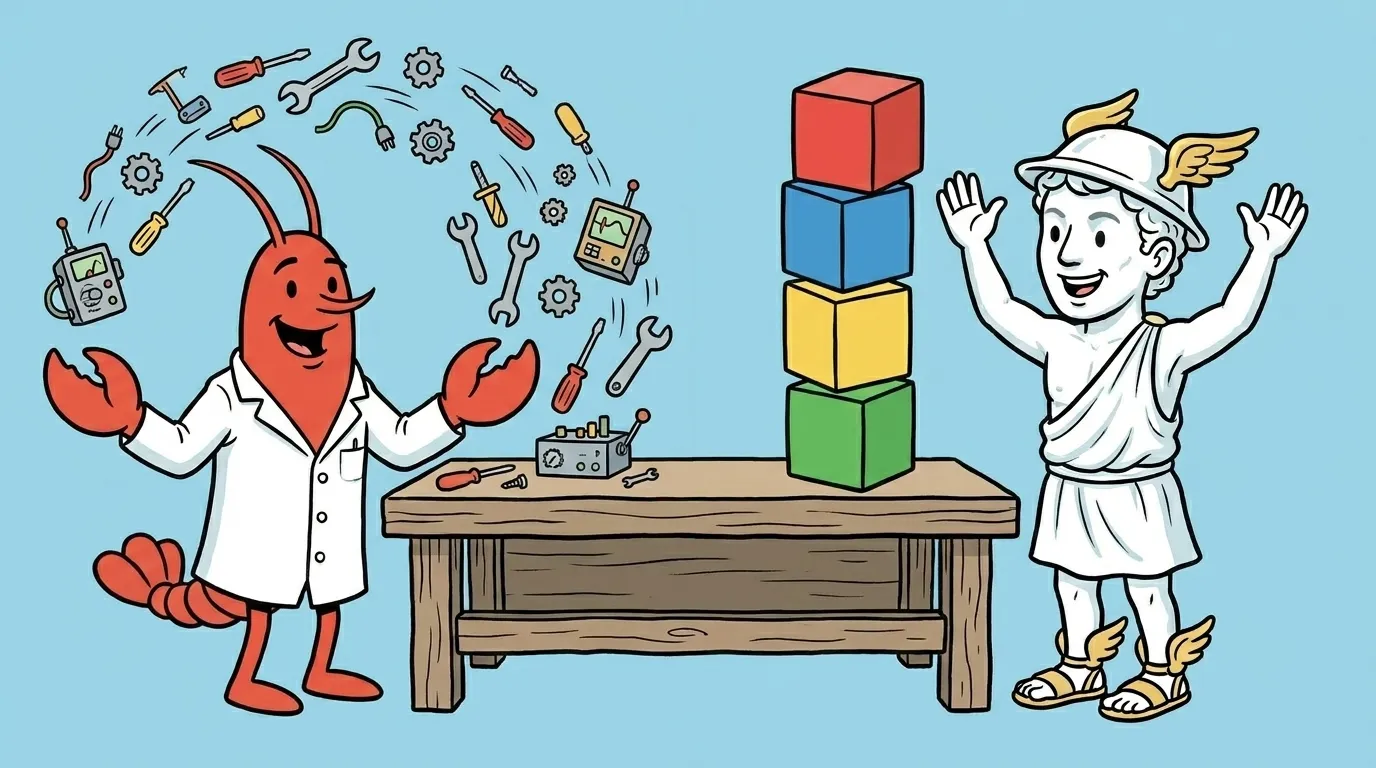
The real split comes down to design philosophy. Both are open-source agent frameworks. Both let you build AI agents that take actions in the world. Beyond that, their priorities diverge sharply.
OpenClaw is breadth-first. The central question it answers is: how many external surfaces can your agent reach? Per the OpenClaw GitHub repository, the framework ships with support for 50+ messaging platforms: WhatsApp, Telegram, Slack, Discord, Signal, iMessage, WeChat, Google Chat, and more. Multi-channel routing is a first-class concept, not an afterthought. Extensibility is plugin-shaped, meaning integrations follow a standard interface that teams can build against without touching core framework code.
The strength of this design is reach. One agent definition, many surfaces. The cost is that depth on any single channel can be shallow. OpenClaw’s abstraction layer that makes multi-channel possible is the same abstraction layer that limits how specialized you can get per channel.
Hermes is depth-first. Per Nous Research’s documentation, the central question Hermes answers is: how much better can your agent get at the things it already does? The key mechanism is skill-file auto-generation. When Hermes completes a task successfully, it can generate a Markdown skill file capturing the pattern. On future runs of the same or similar task, it loads that skill file automatically. The agent learns across runs. It gets faster, more accurate, and less expensive per task over time.
Hermes also maintains a persistent memory layer and uses pattern recognition across task histories. What it does not do well out of the box is reach: integrating with 50 different messaging platforms is not what it was designed for. You wire your own integrations, and Hermes executes them deeply.
Why this architectural split matters: these two frameworks solve different halves of the agent problem. OpenClaw solves the “I need to be everywhere” problem. Hermes solves the “I need to get great at this” problem. Most real-world agent deployments need both. That is why the hybrid pattern exists, and why it is where serious operators land.
For a deeper look at OpenClaw’s deployment topology and how it handles the routing layer, our OpenClaw install and security hardening post covers that ground from the infrastructure side.
Production Reality: The Hybrid Pattern
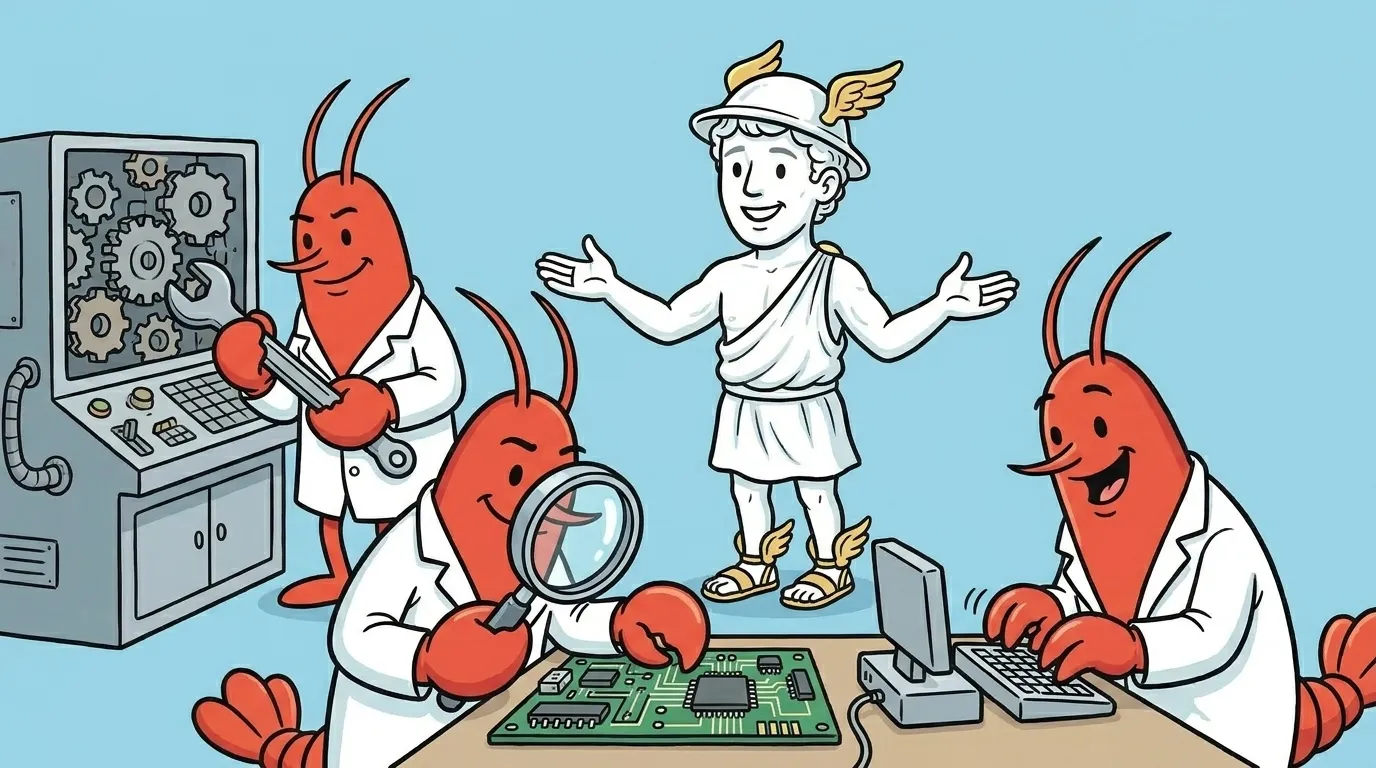
The production pattern we see most often in multi-agent deployments is this: OpenClaw as orchestrator, Hermes as execution specialist. The two frameworks do not compete. They occupy different tiers of the same stack.
The routing layer: OpenClaw handles incoming requests across channels. A message arrives via Slack. Another via WhatsApp. A third via a webhook from your CRM. OpenClaw’s routing logic classifies the request, determines which agent should handle it, and dispatches. This is what OpenClaw is good at. It has the plugin surface, the multi-channel abstraction, and the routing primitives to handle this layer cleanly.
The execution layer: Hermes-driven specialist agents handle the actual work. These agents run the repeated task loops: data extraction, document classification, API orchestration, whatever the repeated workflow is. Because Hermes accumulates skill files over time, the execution gets tighter with each run. The tenth time a Hermes agent runs a particular workflow, it is faster and more accurate than the first time. OpenClaw’s generalist agents do not have this property.
The memory layer: Both frameworks need access to shared context. A request that comes through OpenClaw may reference context Hermes accumulated on a previous task. This is handled through a shared memory store: typically a Redis instance or a vector database both frameworks can read and write. Getting this layer right is where most hybrid deployments run into trouble.
The production pattern we see most often in mature multi-agent fleets follows this exact shape: an orchestration tier handles the inbound routing surface while specialist agents do the depth work on repeated workflows.
Operational gotcha: skill-file collision. This is the one that catches teams. Hermes generates Markdown skill files automatically from successful runs. OpenClaw has plugin behaviors for common actions. When both frameworks have a “preferred” way to handle the same task type, and they share a state layer, you get conflicts. The Hermes skill file says “do it this way.” The OpenClaw plugin defaults say “do it that way.” If your routing layer does not enforce clear ownership boundaries, you get non-deterministic behavior. We have seen teams spend weeks debugging agent behavior that traced back to this. The fix is simple in principle: plan the routing-ownership layer explicitly before you wire them together. In practice, most teams wire first and plan later.
For an exhaustive list of what can go wrong in production OpenClaw deployments, our piece on 7 silent failures in OpenClaw production environments is the best place to start. Most of the failure modes there also apply when OpenClaw is running as the orchestrator tier in a hybrid setup.
When OpenClaw Alone Is the Right Pick
There are use cases where OpenClaw is the clear choice and adding Hermes creates overhead without return.
Multi-channel is your dominant requirement. If the core value of your agent system is that it shows up in the messaging surfaces your customers already use, OpenClaw’s breadth is exactly what you need. A customer support agent covering WhatsApp, Telegram, and Slack simultaneously is OpenClaw’s native territory. Hermes adds nothing to that problem.
Your integrations are varied and low-repetition. If each task your agent handles looks different from the last, Hermes’s skill-file accumulation mechanism provides no benefit. The efficiency gains from learned patterns only materialize when the same patterns repeat. If you have high variety and low repetition, OpenClaw alone is the correct answer.
Your team has plugin development capacity. OpenClaw’s extensibility model rewards teams that can build plugins. If you have engineers who can build against the plugin interface, you get a compounding return from the ecosystem. Hermes’s depth model is less suited to this kind of extension work.
The “we need this on everything” use case. If the brief from your stakeholders is “I need this agent to handle Telegram plus Slack plus WhatsApp plus Discord plus the website chat,” that is OpenClaw. Do not add Hermes to that deployment until you have a specific repeated workflow that would benefit from depth.
Our deployment-shape decision tree covers the deployment topology question in more detail, including when you need a managed deployment versus a self-hosted configuration.
When Hermes Alone Is the Right Pick
There is an equally clear set of conditions where Hermes alone is the right answer and OpenClaw adds complexity without value.
Your workflow has high repetition and benefits from learned patterns. This is Hermes’s core value proposition. Per Nous Research’s documentation, the skill-file system is specifically designed for workflows that repeat: data processing pipelines, document handling, API integration sequences, scheduled extraction jobs. If you run the same class of task 50 or 100 times a day, Hermes gets materially better at it over time. The token cost per task decreases as the skill files accumulate. This is a real operational advantage.
Single-channel deployment. If your agent only needs to operate in one place: one Slack workspace, one internal product, one API surface, OpenClaw’s multi-channel abstraction adds weight without benefit. Hermes running directly against a single integration point is cleaner.
Your team prefers code over plugin config. Hermes’s integration model is code-first. You write the integration, Hermes executes it deeply. If your team is comfortable writing integrations in code and prefers that to maintaining plugin configurations, Hermes’s model fits better.
You are optimizing for per-task quality over surface area. This is the “I do these five things 100 times a day and I need them done as well as possible” use case. Hermes is built for this. OpenClaw is not.
When the Hybrid Is the Right Pick
You need both when multi-channel reach and execution depth are both genuine requirements, not just desirable features.
Multi-agent fleet across mixed channels with repeated workflows. This is the configuration where the hybrid pattern delivers real value. Incoming requests arrive from multiple surfaces. OpenClaw routes them. The requests that map to repeated, learnable workflows get handed to Hermes specialists. The requests that are one-offs or high-variety get handled by OpenClaw’s generalist agents. Both halves of the stack earn their keep.
Multi-step processes where routing and execution depth both matter. Consider an intake workflow that receives requests via Slack, classifies them, routes them to the right specialist, and then runs a multi-step extraction and synthesis process. The intake and routing is OpenClaw. The extraction and synthesis is Hermes. Forcing one framework to handle both layers results in either a shallow execution layer or a routing layer that the framework was not designed for.
Teams investing in long-term agent infrastructure. If you are building infrastructure that you expect to scale over 12-24 months, the hybrid pattern gives you the most flexibility. You can add OpenClaw integrations as your surface area grows and add Hermes specialist agents as your repeated workflows mature.
Operational gotchas in the hybrid configuration:
The skill-file collision issue covered earlier is the most common, but it is not the only one.
Memory-layer reconciliation. When both OpenClaw and Hermes can write to shared state, you need explicit ownership rules. Which framework owns which key namespace? What happens when both write to the same key? If you do not answer these questions before wiring the memory layer, you will answer them later under production pressure.
Observability across the chain. In a single-framework deployment, tracing is contained. In a hybrid, a single user request may touch OpenClaw routing logic, a Hermes skill file, shared memory, and then OpenClaw again for response delivery. Standard observability tooling does not automatically stitch these together. You need to design your tracing and logging to span both frameworks from the start.
Token spend visibility. Both frameworks consume LLM API tokens, and they consume them differently. OpenClaw’s variable routing complexity means its token spend is harder to predict. Hermes’s spend decreases over time as skill files reduce prompt complexity. When you run both, the total spend is harder to attribute and forecast than either framework alone. Budget for the operational overhead of multi-framework cost visibility before you commit to the hybrid.
The multi-agent fleet infrastructure patterns piece covers observability and cost attribution in more depth for teams running multiple agents in production.
Architectural Decision Framework

The right framework depends on your team profile. Here is the honest decision tree.
Solo developer building a single bot. Pick one. If your bot needs to operate across multiple messaging platforms, pick OpenClaw. If it is one-channel with repeated task patterns, pick Hermes. Do not run both on your first build. Get one working end-to-end first.
Small team building a product. If the product is task-focused with high repetition, Hermes is the right foundation. If it is customer-facing across multiple channels, OpenClaw is the right foundation. The hybrid only makes sense if both requirements genuinely apply and you have the engineering bandwidth to maintain two framework surfaces.
Multi-agent fleet operator. Hybrid pattern. The reach-versus-depth tradeoff that makes you want to choose one resolves when you combine them correctly. The routing-ownership design work is non-optional.
Regulated industry or compliance-heavy environment. Self-host whichever you pick. Both are open source. Compliance comes from your deployment shape: where the data goes, how it is encrypted, who can access it. Neither framework will make a non-compliant deployment compliant. The framework choice is secondary to the infrastructure decisions.
Canadian SMB with data sovereignty requirements. The analysis is the same as the regulated industry case. Both frameworks are deployable on Canadian infrastructure. Neither has a managed cloud offering that is Canadian-hosted today. Your hosting choice and your data handling practices matter more than your framework selection. Our AI agent development and deployment service handles the Canadian-infrastructure deployment shape for clients who need a vetted production configuration.
Cost Reality
Both frameworks are open source. The frameworks themselves cost nothing to acquire. This is the correct answer to “what does Hermes cost” and “what does OpenClaw cost.” The follow-on costs are where the real analysis lives.
LLM API costs. This dominates for most deployments. A Hermes deployment running repeated tasks accumulates skill files that demonstrably reduce per-task token spend over time: the skill file captures the successful pattern, so the prompt on subsequent runs is shorter and more targeted. OpenClaw’s token cost is more variable because routing logic complexity drives prompt length and it varies with each request. In our experience running both, Hermes deployments show a measurable cost-per-task reduction over 30-60 days. OpenClaw deployments do not show the same pattern because the task variety is higher.
Deployment cost. Both run on a standard VPS at the baseline. Hermes is more memory-hungry than OpenClaw due to skill-file storage and the persistent memory layer. OpenClaw is more bandwidth-hungry due to multi-channel polling. For typical production workloads, neither difference is large enough to change infrastructure tier decisions. Budget the difference as a rounding error unless you are at very high scale.
Hybrid overhead. Running both frameworks costs more than running one: more maintenance, more observability, more operational surface area. The per-task efficiency gains from the hybrid configuration usually offset this overhead once the deployment has had 60-90 days to accumulate Hermes skill patterns. Do not count on the hybrid being cheaper than either standalone framework in the first month. Count on it being more efficient at the six-month mark.
The Canadian and Sovereignty Angle
Canadian businesses asking about hermes vs openclaw are often asking something more specific: “can I run this on Canadian infrastructure and stay compliant with PIPEDA?” The answer for both frameworks is yes, with caveats.
Neither Hermes nor OpenClaw offers a managed cloud option that is Canadian-hosted today. Both are self-hosted open-source frameworks. “Canadian-hosted” means choosing your infrastructure provider: a Canadian cloud region, a Canadian co-location provider, or on-premises hardware. Both frameworks run on standard Linux infrastructure. There is no technical barrier to a Canadian-hosted deployment of either.
PIPEDA-grade deployment for AI agents means controlling where personal information flows, how it is retained, and who can access it. The framework does not determine compliance. The deployment shape does. Which LLM API provider you use, how you store agent memory, how you log and retain request data: these are the actual compliance levers. Both Hermes and OpenClaw are configurable enough to support a compliant deployment on Canadian infrastructure. Neither does it out of the box.
For clients with hard sovereignty requirements, the practical path is a consulting-led deployment that designs the data-handling architecture first and selects framework components second. Framework selection within a compliant architecture is a secondary decision. Our ai security compliance work covers this for regulated industries and public sector clients.
Conclusion
The “hermes agent vs openclaw” framing will not go away. The search volume is real, the buyer intent is real, and people genuinely want an answer. Here is the most honest answer we can give from operating both:
Hermes is not better than OpenClaw. OpenClaw is not better than Hermes. They have different architectures because they solve different problems. Hermes asks how deep you can go on a given workflow. OpenClaw asks how many surfaces you can reach.
Most teams that start by picking one add the other within six months. This is not because they chose wrong the first time. It is because the requirements that initially dominated (breadth or depth) expand over time to include the other dimension.
The hybrid pattern, with OpenClaw as orchestrator and Hermes as execution specialist, is what we see emerging as the production-grade answer for teams building serious agent infrastructure. Getting there requires planning the routing-ownership layer before wiring anything. It requires explicit memory-layer ownership rules. It requires observability that spans both frameworks from day one. None of that is technically complicated. All of it requires doing it upfront rather than discovering it under production load.
If you are building agent capacity for a Canadian business and want a vetted path to production: book a discovery call. We have shipped this in production and can help you avoid the rework.
Key Takeaways
- OpenClaw is breadth-first: 50+ messaging platforms, multi-channel routing, plugin extensibility. Best when reach across surfaces is the primary requirement.
- Hermes is depth-first: skill-file auto-generation, pattern learning across runs, persistent memory. Best when a defined set of tasks needs to get better over time.
- They solve different halves of the agent problem. The “which is better” framing misses this.
- The hybrid pattern is the production-grade answer for multi-agent fleets: OpenClaw as orchestrator, Hermes as execution specialist. Most serious operators land here within 6-12 months.
- Skill-file collision is the top gotcha when running both. Plan routing ownership before wiring the shared state layer.
- Cost: Both frameworks are free. LLM API costs dominate. Hermes reduces per-task cost over time via skill accumulation. OpenClaw costs are more variable.
- Canadian sovereignty: Both are deployable on Canadian infrastructure. Compliance depends on your deployment shape, not your framework choice.
Frequently Asked Questions
Should I pick Hermes Agent or OpenClaw for my first AI agent build?
For your first build, pick the one that matches your single biggest need. If you need multi-channel reach (multiple messaging platforms), pick OpenClaw. If you need depth on a small number of repeated tasks, pick Hermes. Don't try to run both on your first build. Get one working end-to-end, then add the other if you outgrow it. Most teams that start with one add the other within 6-12 months.
Is Hermes Agent better than OpenClaw in 2026?
Neither is strictly better. Hermes overtook OpenClaw on OpenRouter token throughput in May 2026 (224B vs 186B daily tokens, per OpenRouter rankings), but that reflects different usage patterns, not a quality verdict. Hermes wins on repeated-task depth. OpenClaw wins on multi-channel breadth. Power users increasingly run both, with OpenClaw as orchestrator and Hermes as execution specialist.
Can OpenClaw and Hermes Agent work together?
Yes, and this is the production pattern we see most often in multi-agent fleets. OpenClaw handles routing and multi-platform integration. Hermes handles execution depth on specific repeated workflows. They communicate through a shared memory layer or message bus. Operational gotcha: watch for skill-file collisions when Hermes generates patterns that conflict with OpenClaw plugin behavior.
Is Hermes Agent or OpenClaw easier to self-host?
Roughly equal effort. OpenClaw has more documentation and a larger plugin ecosystem, making troubleshooting easier when you hit issues. Hermes is newer (launched Feb 2026) so the community is smaller but very active. Both can run on a standard VPS. Hermes is more memory-hungry due to skill-file storage; OpenClaw is more bandwidth-hungry due to multi-channel polling.
Which framework is better for Canadian businesses with data residency requirements?
Neither has a Canadian-hosted managed cloud offering today. Both can be deployed on Canadian infrastructure (Canadian VPS providers, on-prem). For PIPEDA compliance, your deployment shape matters more than the framework choice. Both are open source and deployable wherever you can run a Linux server.
What's the biggest gotcha when running Hermes and OpenClaw together?
Skill-file collision. Hermes auto-generates Markdown skill files from successful task runs. OpenClaw has plugin behaviors that overlap with some of these patterns. When both write to shared state or both have a preferred way to handle the same task, the routing layer has to enforce which framework owns which task. We've seen production teams burn weeks on this. Plan the routing-ownership layer before you wire them together.
Stop Googling OpenClaw errors.
Your agents message ours on Telegram. Production-tested OpenClaw fixes. $99/mo.