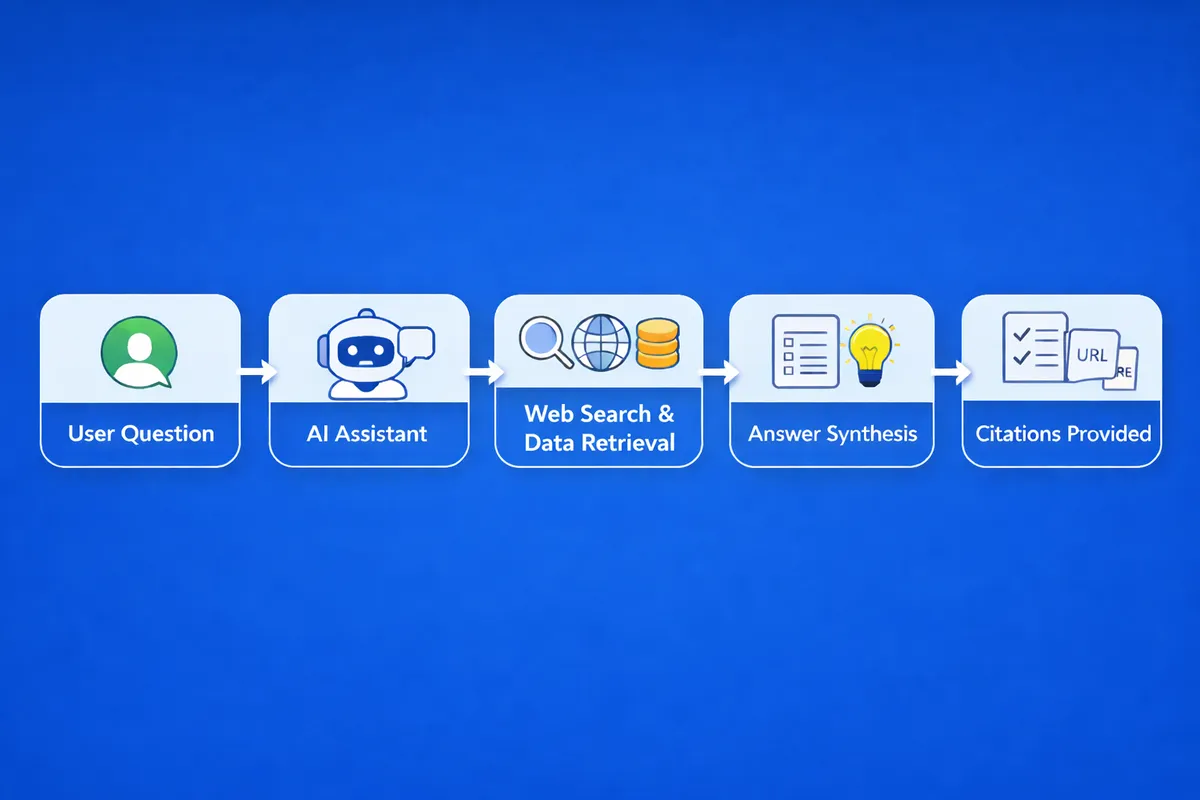
TL;DR: LLMO (Large Language Model Optimization) is how you get recommended when customers ask AI assistants for help. Traditional SEO ranks you on Google. LLMO gets you cited when AI answers directly. With 25% of search shifting to AI by 2026, optimize now or become invisible. Key tactics: answer questions directly in your first sentence, add FAQ schema, show author credentials, include original data, and let AI crawlers access your site.
Contents
- What is LLMO?
- SEO vs LLMO Comparison
- How AI Chooses Sources
- What Gets Cited
- Platform Differences
- The Canadian Angle
- How to Optimize
- The Checklist
- What Doesn’t Work
- Measuring Success
- Key Takeaways
- FAQ
What is LLMO and why should you care?
LLMO stands for Large Language Model Optimization. You might also hear it called GEO (Generative Engine Optimization) or LLM SEO.
Traditional SEO: Optimize your website so Google ranks it higher in search results.
LLMO: Optimize your content so AI assistants cite you when answering questions.
The distinction matters. AI doesn’t rank pages. It synthesizes answers from multiple sources and cites the ones it trusts. Your goal shifts from “rank #1 for this keyword” to “be the source AI quotes when someone asks this question.”
This is not speculation. Gartner predicts traditional search volume will drop 25% by 2026. Semrush’s analysis of 200,000 keywords shows 86% of high-commercial-intent queries already trigger AI-generated answers. The intermediary between your customer and your business is no longer Google’s algorithm. It’s an AI that decides whether to mention you.
The question isn’t whether this matters. It’s whether you’ll adapt before your competitors do.
SEO vs LLMO: Side-by-Side
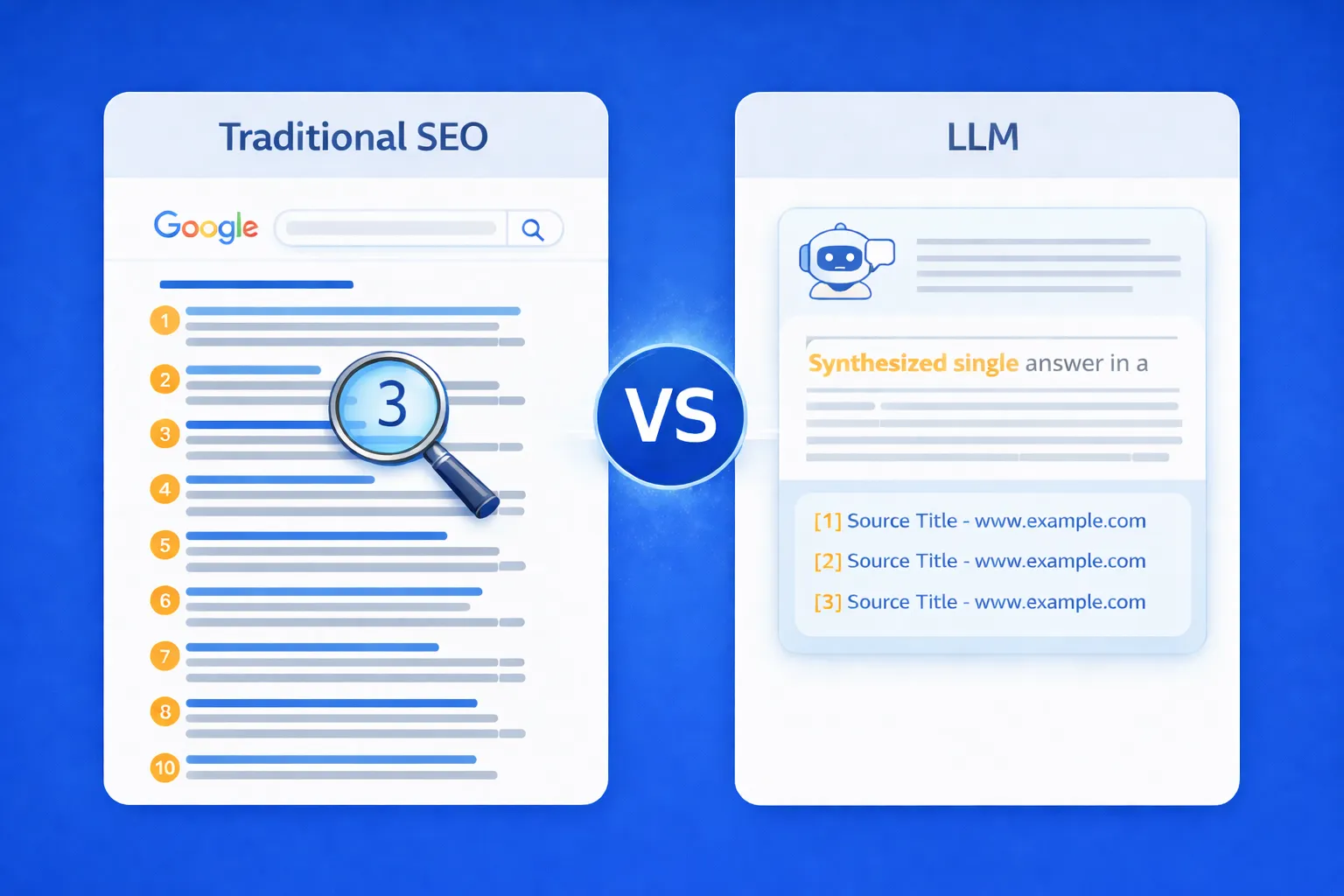
| Aspect | Traditional SEO | LLMO |
|---|---|---|
| Goal | Rank higher in search results | Get cited in AI-generated answers |
| Success metric | Position on Google | Mentioned by ChatGPT/Perplexity |
| Content format | Keyword-optimized pages | Direct answers + structured data |
| Key signals | Backlinks, keywords, site speed | Clarity, credentials, original data |
| User behavior | Clicks through to your site | May never visit. AI delivers the answer. |
| Competition | Other websites | Other sources AI trusts |
| Timeframe | Weeks to months | Days to weeks (for real-time AI) |
How AI search engines choose sources
We tested this ourselves. We asked Claude, ChatGPT, and Perplexity: “Find me an AI consultant in Ontario for my accounting firm.”
Here’s what happened:
| Platform | What It Recommended | Was a Local Consultant Cited? |
|---|---|---|
| Claude | National enterprise firms (EY, KPMG, RSM) | No |
| ChatGPT | Same national players + generic SaaS tools | No |
| Perplexity | SaaS products (AutoEntry, Sage) + Reddit threads | No |
No AI recommended a local, SMB-focused consultant. They either pointed to enterprise firms charging six figures or suggested the customer figure it out themselves with self-serve software.
This is both a problem and an opportunity. The problem: if you’re a local business, AI might be directing your customers away from you. The opportunity: the gap is wide open.
What gets cited (and what gets ignored)
Research across 680 million AI citations reveals clear patterns.
Content that gets cited 30-40% more often:
Direct answers first. AI extracts your opening sentence. If your first paragraph is fluff, you lose.
Original data. First-party statistics, case studies, and proprietary research get attributed. Rehashing someone else’s numbers doesn’t.
Clear structure. FAQ sections, comparison tables, bullet lists, logical headings. AI parses structure faster than prose.
Author credentials. Real names, professional bios, LinkedIn links. AI models look for E-E-A-T signals (Experience, Expertise, Authoritativeness, Trustworthiness).
Freshness. “Last Updated: January 2026” visible on the page. Outdated content gets passed over.
Community presence. Reddit and Quora mentions boost your secondary exposure. Perplexity’s top cited source? Reddit at 6.6% of all citations.
What AI ignores:
- Keyword-stuffed content optimized for 2015 SEO
- Generic blog posts that say nothing original
- Content behind paywalls or login walls
- Pages with slow load times
- Anything without clear authorship
Platform-Specific Optimization
Not all AI assistants are the same. Each platform has different priorities and crawling behaviors. Optimize for all of them, but understand the differences.
| Platform | What It Values | Crawling Behavior | Best Content Type |
|---|---|---|---|
| ChatGPT | Conceptual clarity, structured frameworks, authoritative sources | Browsing feature pulls real-time web results; training data updates periodically | Explainers, frameworks, how-to guides with clear structure |
| Perplexity | Freshness, link authority, data density, Reddit/community discussions | Real-time web crawling, heavy Reddit indexing | Breaking news, current data, community-validated content |
| Claude | Evidence-backed claims, nuanced analysis, source attribution | Training data with emphasis on quality sources | In-depth analysis, case studies, research-backed insights |
| Google AI Overview | Traditional SEO signals still matter (backlinks, domain authority) | Leverages existing Google search index | Content already ranking well in traditional search |
ChatGPT Optimization
ChatGPT’s browsing feature means it can pull from your site in real-time, even if it’s not in the training data.
What works:
- Clear conceptual frameworks (numbered lists, steps, stages)
- Questions as headers with direct answers
- Authority signals (credentials, citations, expertise)
- Structured data (FAQ schema, HowTo schema)
Example: “5 Steps to [Goal]” performs better than “A Guide to [Topic]”
Perplexity Optimization
Perplexity prioritizes fresh content and community validation.
What works:
- Content updated within 30 days (visible “Last Updated” date)
- Reddit mentions and discussions linking to your content
- High link authority (quality backlinks)
- Data-rich content (statistics, charts, tables)
Example: Publishing original research with shareable data gets cited faster than opinion pieces.
Claude Optimization
Claude emphasizes nuance and evidence over simple answers.
What works:
- Evidence-backed claims with source citations
- Acknowledging complexity and trade-offs
- Case studies with specific outcomes
- Original analysis, not just summarized data
Example: “When X works and when it doesn’t” performs better than “Why X is the best”
Google AI Overview Optimization
Google’s AI Overviews blend traditional SEO with LLMO principles.
What works:
- Everything that already works for traditional SEO
- Plus: FAQ sections, direct answers, structured data
- Strong domain authority still matters
- Featured snippets often become AI Overview sources
Strategy: Optimize for traditional SEO first, then layer LLMO tactics on top.
The Canadian angle
Here’s what makes this interesting for Canadian businesses: most LLMO content is American.
When someone asks an AI assistant about automation services in Ontario, the AI often defaults to American sources or generic global content because that’s what dominates its training data and web index.
This creates a gap. If you produce high-quality, Canada-specific content with Canadian case studies, Canadian pricing context, Canadian regulatory considerations, you become the authority for Canadian queries.
Canadian regulatory context matters for LLMO:
When you create content addressing Canadian privacy law (PIPEDA, provincial regulations), data sovereignty requirements, or Canadian-specific compliance, you’re answering questions American competitors can’t. AI assistants recognize jurisdiction-specific expertise.
For Canadian businesses navigating AI adoption, data sovereignty and AI optimization intersect. Canadian-hosted infrastructure combined with LLMO-optimized content creates a defensible advantage. If your business needs to demonstrate Canadian data governance, see our guide to sovereign AI for Canadian SMBs .
Geographic advantage:
For Ontario businesses—whether in Kawartha Lakes , Peterborough , or the Durham Region —the shift to AI-driven search represents both challenge and opportunity. Local expertise combined with LLMO-optimized content puts regional players on equal footing with national firms when AI answers customer queries.
Nobody else is doing this yet. The first movers win.
How to optimize your content for AI citation
1. Use the “Short Answer + Deep Dive” format
Structure every piece of content like this:
## [Question as heading]

**Short answer:** [1-2 sentences that directly answer the question]

[Detailed explanation with evidence, examples, and context]
The short answer is what AI extracts for its response. The deep dive is what establishes your authority.
2. Add FAQ schema
FAQ schema (JSON-LD markup) tells AI exactly which questions your page answers. It’s machine-readable structure that increases your chances of being cited.
{
  "@context": "https://schema.org",
  "@type": "FAQPage",
  "mainEntity": [{
    "@type": "Question",
    "name": "What is LLMO?",
    "acceptedAnswer": {
      "@type": "Answer",
      "text": "LLMO (Large Language Model Optimization) is the practice of optimizing content to be cited by AI assistants like ChatGPT and Perplexity."
    }
  }]
}
3. Include original data
Don’t just cite statistics. Create them. Run a survey. Analyze your own client data (anonymized). Share what you’ve learned from actual projects.
AI citations favor primary sources. Be the source.
4. Show your credentials
Every page should have:
- Author name and title
- Brief bio with relevant experience
- Link to professional profile (LinkedIn)
- “Last Updated” date visible
AI is looking for signals that you know what you’re talking about. Make them obvious.
5. Let AI crawlers in
Check your robots.txt file. Make sure you’re not blocking:
- GPTBot (ChatGPT’s crawler)
- PerplexityBot
- ClaudeBot
- Googlebot (for AI Overviews)
If AI can’t crawl your site, it can’t cite you.
Optional: Implement llms.txt
llms.txt is an emerging protocol that tells AI crawlers how to interpret your site. Similar to robots.txt but specifically for LLMs. It’s not widely adopted yet, but early implementation signals technical sophistication.
Basic llms.txt example:
# llms.txt
# Instructions for AI crawlers

Site name: Your Business Name
Description: Brief description of what you do
Focus: Your core services or expertise areas
Location: Your city or region
Services: /services/
Blog: /blog/
Contact: /contact/
Place it at your domain root: yoursite.com/llms.txt
This gives AI assistants structured context about your site. While not widely adopted yet, early implementation signals technical sophistication.
6. Build community presence
Perplexity indexes Reddit and Quora heavily. If people are discussing your expertise in these communities and linking to your content, you gain secondary citation exposure.
Reddit citations increased 87% in mid-2025. Perplexity now cites Reddit at 6.6% of all sources—higher than many traditional news outlets.
Practical Reddit playbook for SMBs:
- Find your subreddits. Where do potential customers ask questions about your industry?
- Answer genuinely. Provide value first. Link to your content only when it directly answers the question.
- Be consistent. Weekly participation builds recognition and trust.
- Don’t pitch. Reddit punishes self-promotion. Help people, don’t sell to them.
- Track mentions. Set up Google Alerts for your brand + Reddit to see when you’re discussed.
Example: If you’re a Canadian accounting consultant, participate in r/PersonalFinanceCanada, r/smallbusiness, r/Entrepreneur. Answer tax questions. Link to your detailed blog post on Canadian tax optimization only when it’s the best answer.
This doesn’t mean spamming links. It means genuinely participating in discussions and being helpful. The citations follow naturally.
The 6-Point LLMO Checklist

Before publishing any content, verify:
- Direct answer in first paragraph. Can AI extract a complete answer from your opening sentences?
- FAQ schema implemented. Is your FAQ section marked up with JSON-LD?
- Author credentials visible. Name, title, bio, LinkedIn link on page?
- “Last Updated” date shown. Is freshness obvious to crawlers and readers?
- Original data included. Any first-party stats, case studies, or unique insights?
- AI crawlers allowed. GPTBot, PerplexityBot, ClaudeBot permitted in robots.txt?
If you can check all six, your content is LLMO-ready.
What Doesn’t Work (Anti-Patterns)
LLMO optimization has pitfalls. Avoid these common mistakes that hurt more than help.
Over-Optimization Signals
AI assistants detect manipulation. These patterns trigger de-prioritization:
- Keyword stuffing for AI. Repeating “best Canadian AI consultant” 20 times in your content gets flagged, just like it does in traditional SEO.
- Fake credentials. Claiming expertise you don’t have. AI cross-references claims against other sources.
- Scraped or AI-generated fluff. Thin content with no original insights gets ignored. AI can detect AI-written content that adds no value.
- Citation loops. Citing yourself as the source for claims without external validation.
Common LLMO Mistakes
1. Answering the wrong questions
Don’t optimize for questions nobody asks. Research actual search queries. Use “People Also Ask” boxes, Reddit discussions, and customer support questions to find real information gaps.
2. Ignoring freshness
Publishing great content in 2023 and never updating it means AI cites the 2025 version from your competitor instead. Update timestamps matter.
3. Blocking AI crawlers
Some businesses block GPTBot thinking it protects their content. It just makes them invisible to ChatGPT users. If you don’t want to be cited, block crawlers. If you do, allow them.
4. No evidence for claims
“We’re the best AI consultant in Ontario” without case studies, client outcomes, or verifiable data gets ignored. Back up claims with evidence.
5. Burying the answer
If someone has to read 800 words before finding the answer to the headline question, AI extracts from a competitor who answered in the first paragraph.
What AI Penalizes
These patterns actively hurt your citation chances:
| Anti-Pattern | Why It Hurts | Fix |
|---|---|---|
| Clickbait headlines | Promise ≠ delivery. AI detects when content doesn’t match the title. | Write descriptive, accurate headlines that match content. |
| Paywalls | AI can’t cite what it can’t read. | Offer free excerpts or summaries; reserve premium content for different purposes. |
| No authorship | “Written by Admin” or no author at all signals low-quality content. | Add real names, bios, credentials. |
| Outdated content | 2022 statistics in 2026 content gets skipped for fresher sources. | Update regularly. Show “Last Updated” date. |
| Mobile-unfriendly | Poor UX signals low-quality site even if content is good. | Responsive design, fast load times. |
The principle: AI rewards clarity, honesty, and value. Anything that feels manipulative or low-effort gets deprioritized.
Measuring success
LLMO is harder to measure than traditional SEO, but not impossible. Here’s how to track your progress.
Manual Testing Protocol
Test your target queries weekly across platforms. Document what you find.
Step-by-step:
- Identify 5-10 core queries your ideal customer would ask (“AI consultant for accounting firm Ontario” or “how to automate customer service”)
- Test each query in:
- ChatGPT (with browsing enabled)
- Perplexity
- Claude
- Google AI Overview (if it appears)
- Document results:
- Are you cited? Yes/No
- Position (1st, 2nd, 3rd source mentioned?)
- Accuracy (Is the AI representing your services correctly?)
- Competitors cited (Who’s beating you?)
- Track changes weekly. Watch for citation gains over time.
Tools for LLMO Measurement
| Tool | What It Does | Cost | Best For |
|---|---|---|---|
| Profound | Tracks your brand mentions across AI platforms | Paid (pricing varies) | Enterprises with budget for dedicated tracking |
| Manual testing | Search queries yourself across platforms | Free | SMBs starting LLMO optimization |
| Google Analytics 4 | Track referrals from AI platforms | Free | Measuring traffic from AI citations |
| Google Search Console | Monitor AI Overview appearances | Free | Tracking Google AI Overview performance |
Realistic expectations: Perplexity citations can appear within days. ChatGPT citations take weeks to months depending on browsing vs training data. Claude citations depend on training data updates (less frequent).
GA4 Referral Segment Setup
Track visitors coming from AI assistants:
- Go to GA4 > Explore > Create new exploration
- Add filter: Source contains “chatgpt” OR “perplexity” OR “claude” OR “bard”
- Save as segment: “AI Referrals”
- Compare metrics:
- Conversion rate (often 3-5x higher than organic search)
- Time on site
- Pages per session
- Goal completions
What to watch: If AI referrals convert better than organic (which research suggests they do at 4.4x), prioritize LLMO optimization over marginal traditional SEO gains.
Form Tracking
Add “How did you find us?” to contact forms with these options:
- Google search
- AI assistant (ChatGPT, Perplexity, Claude)
- Social media
- Referral
- Other
Track this monthly. AI-driven inquiries often spike 3-6 months after LLMO implementation.
Citation Quality Audit
Not just whether you’re cited, but how accurately.
Questions to ask:
- Is the AI representing your services correctly?
- Are pricing or capabilities accurate?
- Is outdated information being cited?
- Are you being confused with competitors?
If citations are inaccurate: Update your content to be more explicit. Add structured data. Remove ambiguous language.
What this means for your business
The businesses that adapt to LLMO early will capture attention that their competitors don’t even know exists yet.
If you’re a local service provider, this is especially important. AI tends to default to national players and self-serve software. By creating Canada-specific, LLMO-optimized content, you can become the answer for queries in your market before anyone else shows up.
If you’re already investing in content marketing, the adjustment isn’t dramatic. Better structure, clearer answers, visible credentials, FAQ schema. These are improvements that also help traditional SEO.
The cost of ignoring this? Gradual invisibility. As more customers start their search with AI, businesses that don’t show up in AI responses will see declining inbound interest and wonder why their marketing stopped working.
Glossary
| Term | Definition |
|---|---|
| LLMO | Large Language Model Optimization. Optimizing content to be cited by AI assistants. |
| GEO | Generative Engine Optimization. Another name for LLMO. |
| LLM | Large Language Model. AI systems like ChatGPT, Claude, Gemini. |
| E-E-A-T | Experience, Expertise, Authoritativeness, Trustworthiness. Google’s quality signals, also used by AI. |
| SERP | Search Engine Results Page. Traditional Google results. |
| AI Overviews | Google’s AI-generated answers at the top of search results. |
| Schema markup | Structured data (JSON-LD) that helps AI understand your content. |
| FAQ schema | Specific markup that identifies question-and-answer content. |
Key Takeaways
- LLMO is not optional. 25% of search volume shifts to AI by 2026.
- AI citations ≠ rankings. You can rank #1 on Google and still be invisible to AI.
- Structure matters more than keywords. AI extracts direct answers, not keyword-stuffed prose.
- Canadian businesses have first-mover advantage. Most LLMO content is American. Localize and win.
- The real competitor is DIY. AI often recommends self-serve software over consultants.
- Start with the checklist. Six changes can make existing content LLMO-ready.
FAQ
Does LLMO replace SEO?
No. LLMO and SEO work together. Strong SEO foundations (quality content, good site structure, domain authority) also help with AI citations. Think of LLMO as an extension of SEO for the AI era, not a replacement.
How long until I see results?
AI citations depend on your content being crawled and indexed by AI platforms. New content can appear in Perplexity results within days. ChatGPT’s training data updates less frequently, but its browsing feature pulls real-time results. Expect 2-4 weeks for initial traction, 3-6 months for meaningful citation presence.
Does this work for any industry?
Yes, but some industries benefit more immediately. Service businesses, consultants, B2B providers, and anyone selling expertise see the biggest gains. AI is often asked “who can help me with X?” and if you’re the answer to that question, LLMO matters.
What if AI misrepresents my business?
This happens. AI sometimes cites inaccurate pricing, outdated services, or incorrect capabilities. The solution is clearer, more structured content that leaves less room for misinterpretation. If you see consistent errors, update your content to be more explicit about what’s current.
How much does LLMO cost?
If you’re already creating content, the marginal cost is low. Mostly structural changes and schema markup. If you’re starting from scratch, budget for content creation just as you would for traditional SEO. The difference is in format and optimization, not fundamental cost structure.
What is llms.txt?
llms.txt is an emerging protocol that tells AI crawlers how to interpret your site. Similar to robots.txt but specifically for LLMs. It’s not widely adopted yet, but early implementation signals technical sophistication.
You can add basic information about your site structure, focus areas, and key pages. Place it at your domain root (yoursite.com/llms.txt). While not required, it shows you’re ahead of the curve on LLMO best practices.
How do I know if ChatGPT is citing me?
Test manually by asking questions your content should answer. Use tools like Profound (paid) or manually check ChatGPT and Perplexity responses weekly. Set up GA4 segments to track referral traffic from AI domains.
Create a testing protocol: identify 5-10 core queries your customers would ask, test them weekly across ChatGPT, Perplexity, and Claude, and document whether you’re cited and in what position. Track changes over time to measure LLMO effectiveness.
Does AI citation help traditional SEO?
Indirectly, yes. Content optimized for AI citations (clear structure, direct answers, original data) also performs well in traditional search. Plus, AI citations can drive traffic that improves engagement metrics, which Google factors into rankings.
Think of LLMO as an extension of good SEO practices, not a replacement. The fundamentals remain: quality content, clear structure, authoritativeness. LLMO adds optimization for how AI systems parse and cite that content.
Next Steps
If you’re a Canadian business wondering whether AI is recommending you or recommending your competitors, we can help you find out.
Kaxo Technologies specializes in AI automation and integration for Canadian businesses. We practice what we preach: this article is structured for LLMO, and we track whether AI cites us for the queries that matter.
Want to know where you stand? Book a discovery call and we’ll run your business through the same AI search simulation we use for ourselves.
Kaxo Technologies is an AI consulting firm based in Ontario, Canada. We help businesses automate workflows, integrate AI tools, and build systems that actually work. Canadian-hosted infrastructure. Honest advice. No buzzwords.
Soli Deo Gloria
Back to Insights