
TL;DR: Data sovereignty means your data is governed by the laws of one country only. It is a legal concept, not a geographic one: a server physically located in Canada can still be subject to US law if the company that owns it is incorporated in the United States. Data sovereignty meaning is distinct from data residency, which only describes where data physically sits. Understanding that distinction matters more than ever as regulators tighten requirements and foreign governments expand their legal reach into cloud infrastructure.
Contents
- What is data sovereignty (and what it isn’t)
- Data sovereignty vs data residency: the distinction that matters
- Why data sovereignty matters
- Data sovereignty by region
- How to evaluate whether your data is actually sovereign
- Key Takeaways
- FAQ
What is data sovereignty? At its simplest, data sovereignty is the principle that data is governed by the laws of the country in which it is collected or processed. It is a legal concept, not a technical one. The distinction that matters: data sovereignty is about legal jurisdiction, not physical location. A server rack in Toronto owned by a company headquartered in Virginia is still subject to Virginia’s law, and by extension US federal law, for the data it holds.
That single fact invalidates a large portion of what gets marketed as “sovereign cloud” today.
What is data sovereignty (and what it isn’t)
The plain data sovereignty meaning: your data operates exclusively under the legal authority of one country. That country’s courts, regulators, and government agencies are the only entities with legal standing to access, compel, or govern that data.
What it doesn’t mean: data sovereignty is not the same as data security, data privacy, or even data residency. You can have world-class encryption, strict access controls, and physical servers inside your borders, and still lack sovereignty if the entity operating those servers is legally accountable to a foreign government.
The governing question is always: whose law applies to the company that holds your data?
The answer to that question is a matter of corporate structure and jurisdiction, not of server location, SLA wording, or marketing copy.
Data sovereignty vs data residency: the distinction that matters
These two terms get conflated constantly. They are not the same.
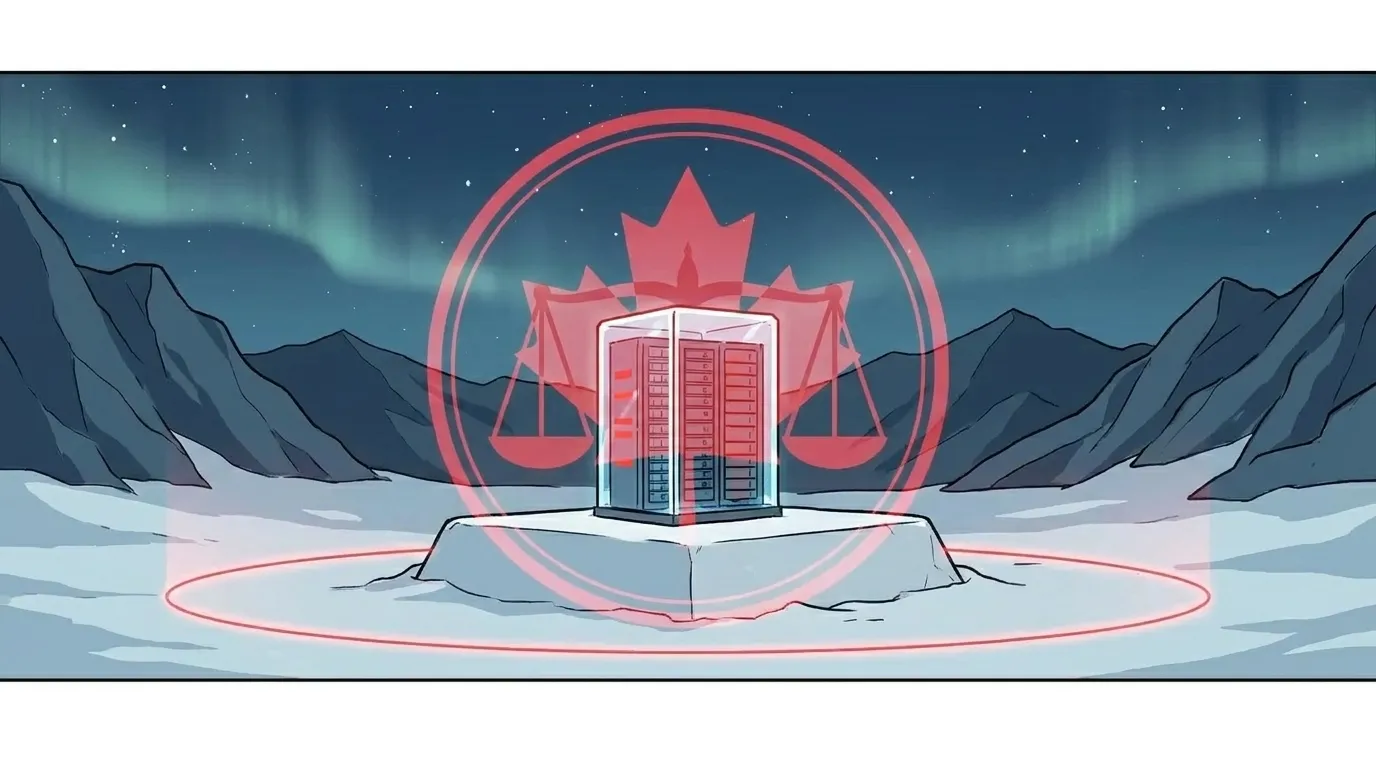
Data residency means data is physically stored within a specific geographic location. A company can contractually commit to keeping your data within Canadian borders. That is residency.
Data sovereignty vs data residency comes down to this: residency tells you where the data sits. Sovereignty tells you whose law governs it. Those are independent variables.
The gap shows up clearly with US cloud providers. A US-incorporated company that operates Canadian data centres can offer you data residency. Your data stays in Canada. But that same company remains subject to US law, including the CLOUD Act , which gives US federal agencies the authority to compel production of data from US-based cloud and communications providers, under US legal process, regardless of where that data is stored.
The result: data physically in Canada, legally reachable from Washington. That is residency without sovereignty.
Why data sovereignty matters
The practical consequences break into three categories: legal compulsion, regulatory compliance, and the AI dimension.
Legal compulsion
The US CLOUD Act (Clarifying Lawful Overseas Use of Data Act) means any US-based cloud or communications provider can be ordered to produce data stored anywhere in the world. No local incident required. No Canadian court order required. The exposure exists by virtue of who owns the infrastructure.
Regulatory compliance
In health, finance, and legal sectors, the standards for data handling have teeth. A breach caused by a foreign-government access order, not a local incident, can still constitute a regulatory failure. For Canadian organizations, PIPEDA and Quebec Law 25 create specific duties around personal information that can be complicated by foreign-law exposure in ways that are not always obvious until an incident occurs.

The AI dimension
AI processing adds a layer most organizations haven’t addressed. When your business data is ingested by an AI model for analysis, summarization, or automation, the question of where that processing happens and under whose law becomes a new data sovereignty surface. Sending regulated Canadian health records to a US-based AI API creates exposure that storing those same records locally would not. The sovereignty question follows the data, and AI pipelines move data constantly.
Data sovereignty by region
Different jurisdictions have taken different approaches. The three that matter most for Canadian businesses:
European Union (GDPR)
The EU’s General Data Protection Regulation created a comprehensive data protection framework that restricts transfers of personal data to countries without adequate protections. Sovereignty is baked into the design: data about EU residents is subject to EU law, and the EU has actively pushed back against CLOUD Act exposure for European data.
United States (CLOUD Act)
The US took the opposite approach. The CLOUD Act explicitly extends US jurisdictional reach over data held by US-based cloud and communications providers regardless of storage location. The extraterritorial nature of this statute is why “data stored in Canada” is not a complete answer when the provider is a US company.
Canada (PIPEDA + Quebec Law 25)
Canada’s federal privacy law, the Personal Information Protection and Electronic Documents Act , governs how private-sector organizations collect, use, and disclose personal information. Quebec’s Law 25 (An Act to modernize legislative provisions as regards the protection of personal information), which amends the province’s private-sector privacy act, applies stricter requirements provincially and has become a meaningful compliance benchmark for the whole country.
Real data sovereignty Canada means Canadian-owned infrastructure, Canadian corporate structure for the provider, and contracts that explicitly exclude foreign-law access. Those are the conditions a sovereign cloud in Canada has to meet. For a full Canada-specific breakdown of what the law requires and how to achieve it, see our guide to data sovereignty in Canada . For a deeper look at how to vet Canadian providers and identify sovereignty-washing in vendor sales decks, see the Canadian sovereign cloud buyer’s guide .
How to evaluate whether your data is actually sovereign
This is where the rubber meets the road. Most vendor claims don’t survive a structured vetting process.

Five questions to ask any cloud provider or AI platform:
1. Who ultimately owns this company, and where are they incorporated?
Marketing copy about Canadian operations doesn’t tell you who the legal parent is. Look at the corporate structure, not the marketing site. If the parent is incorporated in the US, UK, or another jurisdiction with broad extraterritorial reach, you have residency risk, not sovereignty.
2. Does the contract explicitly state that no foreign law governs access to my data?
Contractual commitments to data residency are common. Contractual commitments to full sovereignty, including explicit exclusion of foreign-law compelled access, are rare. Read the data processing agreement, not just the privacy policy landing page.
3. Who are the sub-processors, and where are they based?
A Canadian primary provider can still expose your data through US-based sub-processors handling support, monitoring, logging, or backup. Ask for the complete sub-processor list, not just a summary.
4. Are there third-party audits, not just self-attestations?
Sovereignty claims backed by independent audit (SOC 2, ISO 27001, or sector-specific frameworks) carry more weight than internal certifications. Self-attestation is not verification.
5. What happens if a foreign authority issues a legal demand?
Some providers have published transparency reports and commit to notify customers before complying with foreign demands where legally permitted. Others don’t. The answer tells you how seriously the provider takes the sovereignty commitment versus treating it as a marketing angle.
A “yes” on all five is a strong signal. Vague answers on any of them mean residency, not sovereignty, regardless of where the servers are located. For a full vetting framework and guidance on what to do with the answers, see our AI security and compliance services .
Key Takeaways
- Data sovereignty is a legal concept, not a geographic one. Where servers are located and whose law governs them are separate questions.
- Data residency and data sovereignty are not the same thing. Residency tells you where data sits. Sovereignty tells you whose law applies.
- The US CLOUD Act is the biggest practical risk for Canadian organizations. US-headquartered cloud providers can be compelled to produce your data regardless of where it is stored.
- AI pipelines are a new sovereignty surface. Any AI processing of sensitive data exports that data to whatever jurisdiction governs the AI provider.
- Vendor claims require structured vetting. Corporate ownership, sub-processors, contractual language, and audit records matter more than marketing.
- Real sovereignty requires a Canadian-owned, Canadian-structured provider with contracts that explicitly exclude foreign-law access.
Frequently Asked Questions
What is data sovereignty?
Data sovereignty is the principle that data is governed by the laws of the country where it is collected or processed. It is a legal concept, not a technical one. Where data physically sits is a separate question: a server in Canada owned by a US company still falls under US law for the data it holds.
What is the difference between data sovereignty and data residency?
Data residency means data is physically stored within a specific country or region. Data sovereignty means the data is governed only by that country's laws. You can have residency without sovereignty: a Canadian data centre operated by a US-headquartered company gives you the first but not the second, because US law, including the CLOUD Act, still reaches that data.
Why does data sovereignty matter for businesses?
Foreign governments can compel cloud providers to hand over data stored abroad if those providers are headquartered in their jurisdiction. The US CLOUD Act is the clearest example: it requires US-based cloud providers to produce data under US legal process, regardless of where the data is stored. For regulated industries, health, finance, legal, the wrong provider choice can mean a compliance breach without any local incident ever occurring.
Does storing data in my country guarantee data sovereignty?
No. Storing data locally guarantees data residency, not sovereignty. If the provider is owned or controlled by a foreign company, the laws of the parent company's country can still apply. The governing question is: whose law applies to the entity that holds your data, not where the servers are racked.
What is data sovereignty in Canada?
In Canada, data sovereignty means your data is governed exclusively by Canadian law, primarily PIPEDA at the federal level and Quebec Law 25 at the provincial level. Achieving this requires that your provider be a Canadian-owned entity with no US parent, and that contracts explicitly exclude foreign-law access. Many Canadian-labelled cloud offerings fall short of this standard.
How do I know if my cloud provider gives me real data sovereignty?
Ask five questions: Who owns the provider, and in which country is the ultimate parent incorporated? Does the contract explicitly state that no foreign law governs data access? Who are the sub-processors, and where are they based? Does the provider carry third-party audits, not just self-attestations? Are there contractual guarantees, not just marketing claims? If any of those answers are vague, you likely have residency, not sovereignty.