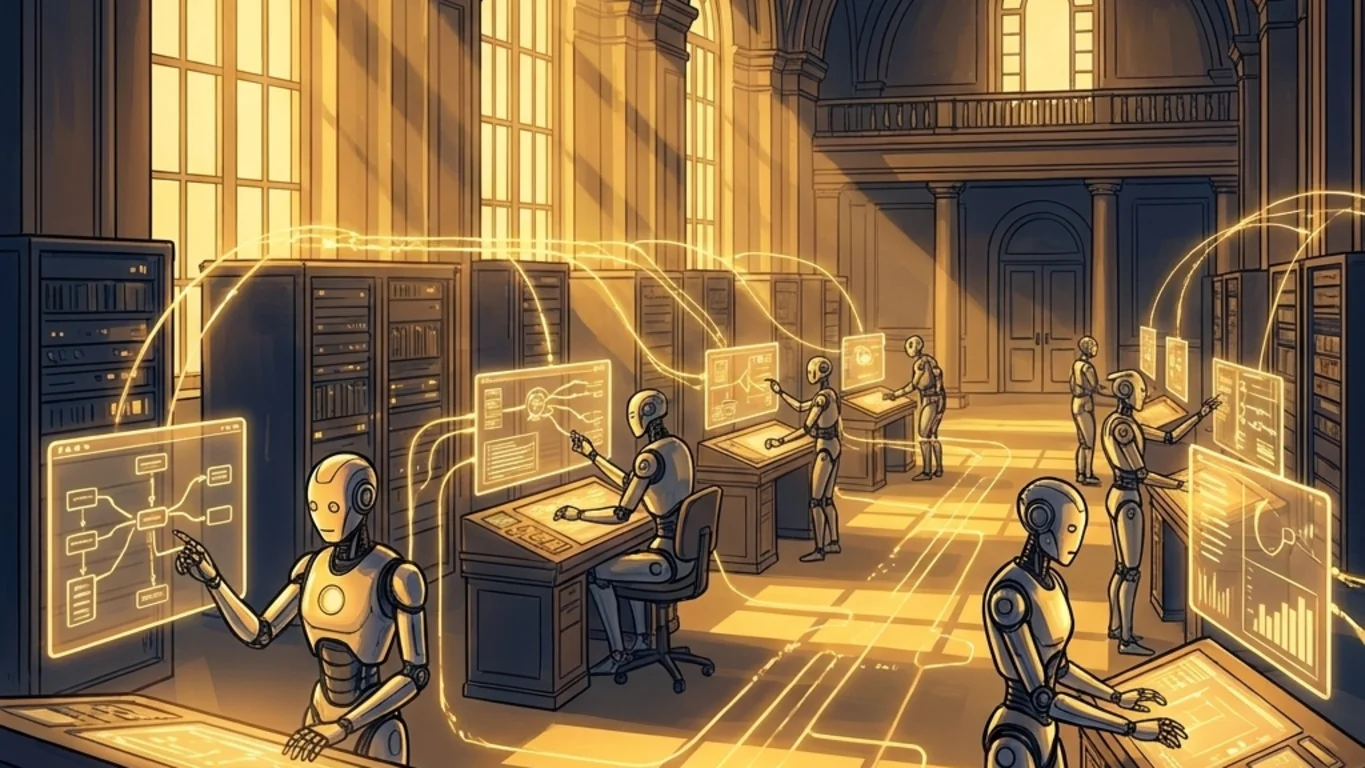
AI Agent Development: Custom AI Agents for Canadian Businesses
Custom AI agents, built and run in production, with sovereign Canadian hosting. Software that runs your process from start to finish, not no-code glue.
Book a Discovery CallMost companies asking about AI agents do not need another chatbot. They need software that can actually run a process: take a task from start to finish, make the small judgment calls along the way, and do it reliably enough to trust in production. That is what AI agent development is, and it is what Kaxo builds.
We are an AI agent development company. We design, build, and operate custom AI agents for businesses, and we host them in Canada.
What custom AI agent development is
A custom AI agent is software that pursues a goal on its own across multiple steps, rather than responding to one instruction at a time. Instead of a person clicking through a workflow, the agent runs it: reading the inputs, deciding what to do, calling the tools it needs, and handling the cases that do not fit a template.
“Custom” is the important word. The agent is built around your actual process and your systems, not a generic template you bend to fit. That is the difference between buying a tool and having a system built for the job.
When you need custom agents (and when you don’t)
Be honest with yourself about the work:
- No-code tools fit when the task is simple and linear: move data between apps, send a notification, trigger an action. Zapier, Make, and off-the-shelf chatbots do this well and cheaply.
- Custom agents fit when the work needs judgment, runs many steps, has to handle exceptions, or touches systems the glue tools cannot reach. If you have tried to force a no-code tool to do real reasoning and hit a wall, that wall is the signal.
We will tell you which one you need. If your problem is a no-code problem, building a custom agent is overkill and we will say so.
How we build, and run, AI agents
The thing that separates us from most of the market: we build on our own production AI agents, not on a stack of no-code connectors. We run AI agents in production ourselves, every day, so the systems we build for clients come from real operating experience with what breaks and what holds up.
We build on Claude and our own custom agent platform, scope a fixed first phase so the risk is contained, and hand you a system you own and can grow, rather than a subscription you rent.
Related reading
- AI agents for business: use cases and ROI covers where agents pay for themselves and where they do not.
- How to choose an AI agent development company sets out what to ask a vendor before you sign anything.
- A lead qualification agent, built step by step walks through a real workflow end to end.
- AI agent observability explains what to log and alert on once an agent is live, which is the part most teams reach last.
Built and hosted in Canada
Kaxo is Canadian, and we can build and host your agents on Canadian infrastructure. For companies governed by PIPEDA, Quebec Law 25, or sector data-residency rules, where your agents run is not a detail - what data sovereignty actually means sets out the distinction that matters here. Most AI platforms default to US infrastructure. We do not.
What you get
- A custom AI agent built around your real process, not a template.
- A fixed, scoped first phase so you know the cost and the outcome before you commit.
- A system you own, built to grow into more agents over time.
- Canadian hosting and data residency when you need it.
- Guidance from a team that runs its own AI agents in production.
If you are trying to decide whether custom AI agents are right for your business, the fastest first step is a conversation about the specific process you want one to run. Reach out and we will tell you, honestly, whether it is worth building.
Frequently Asked Questions
What is an AI agent development company?
An AI agent development company builds custom software agents that carry out multi-step tasks on their own, such as handling a workflow end to end, rather than just answering a single prompt. A real development company builds and operates these agents in production, not just configures an off-the-shelf chatbot. Kaxo designs, builds, and runs custom AI agents for businesses, with hosting in Canada.
How much does custom AI agent development cost?
It depends on scope. A focused first agent or automation is a defined project; an ongoing program that builds and operates multiple agents is a larger engagement. The honest way to compare is by outcome and what the agent owns end to end, not by hourly rate. We scope a fixed first phase so you know what you are getting before you commit. Reach out for a scoped quote.
What is the difference between custom AI agents and no-code tools?
No-code tools like Zapier or Make connect apps and trigger simple actions, which is fast and inexpensive but limited to what those platforms allow. Custom AI agents are built to handle judgment, multi-step work, and edge cases those tools cannot reach, and you own the system rather than renting per-task platform capacity. If your workflow is simple, no-code is the right call; if it needs to reason and run a real process, you need custom agents.
Do you build and host AI agents in Canada?
Yes. Kaxo is Canadian and can build and host your AI agents on Canadian infrastructure, which matters when your data is governed by PIPEDA, Quebec Law 25, or sector rules in areas like health, legal, and finance. Many AI platforms run on US infrastructure; for buyers who need data residency, Canadian hosting is the cleaner path.